When Olive Annis Watts was born on July 16, 1873, in Londonderry, New Hampshire, her father, Charles Watts, was 32, and her mother, Miriam P. Annis Watts, was 35.
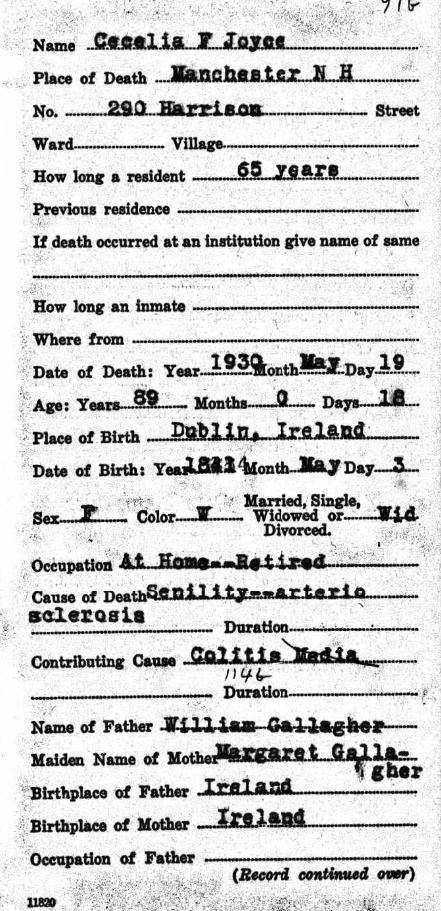
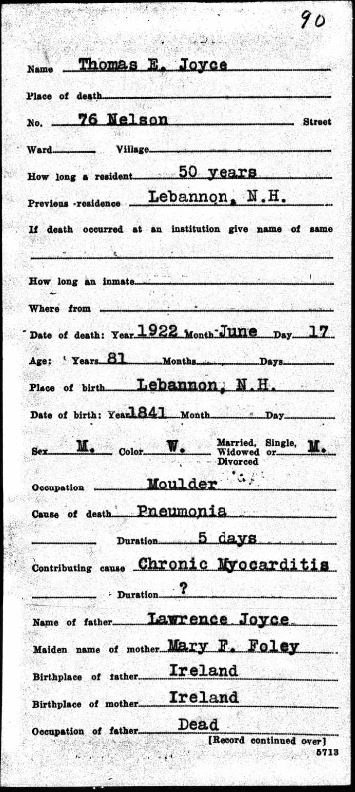
Olive married William Lawrence Joyce on June 30, 1897, in Derry, New Hampshire. They had two children during their marriage. She had one brother and five sisters.
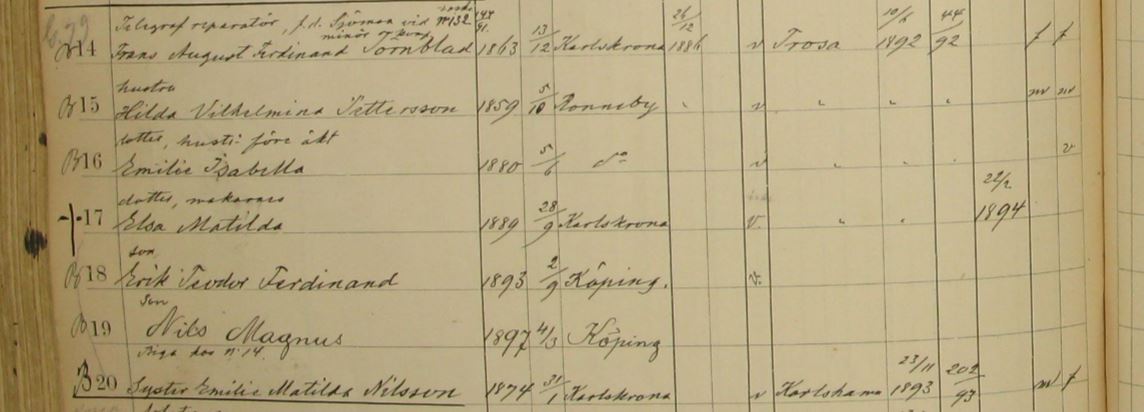
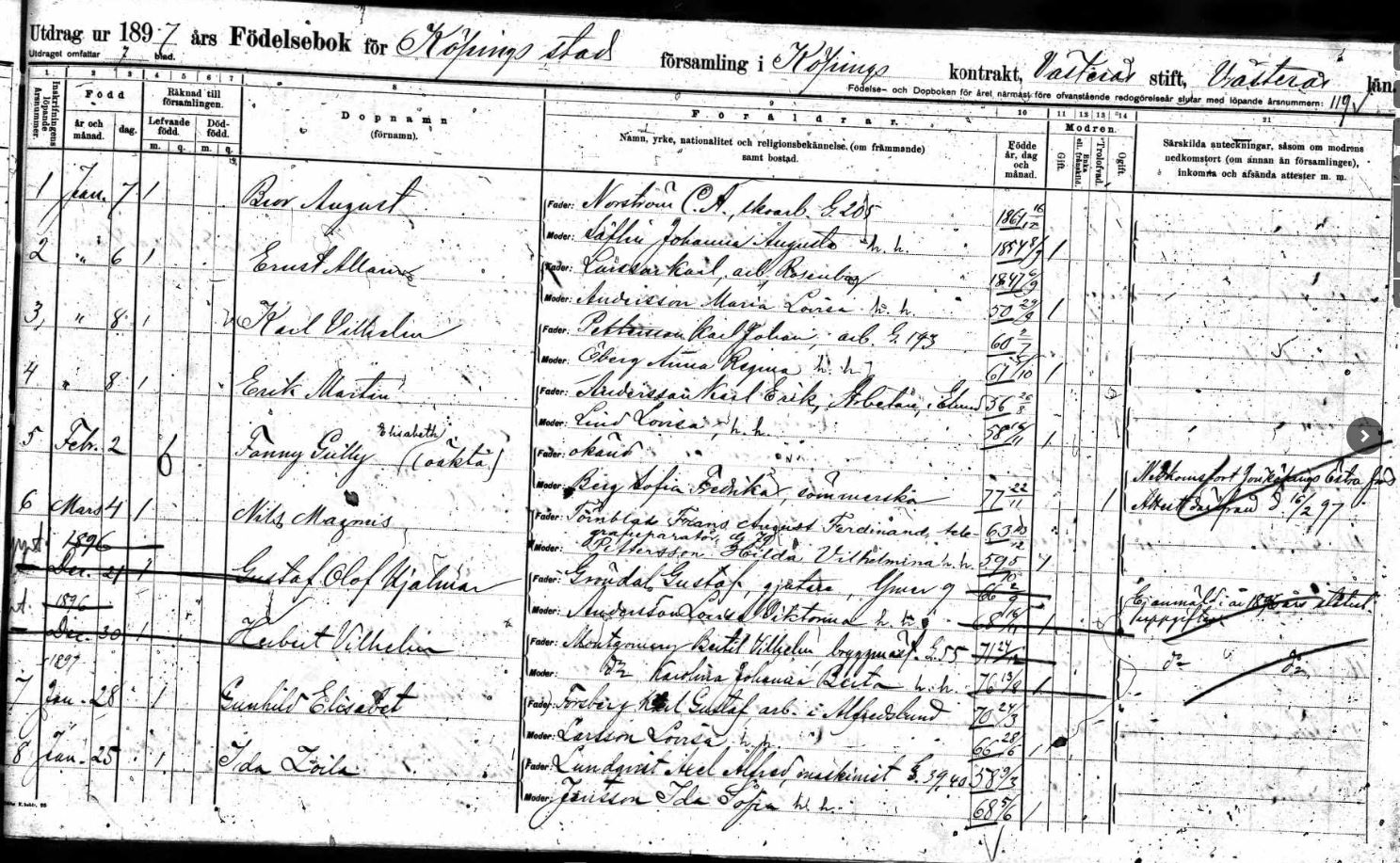
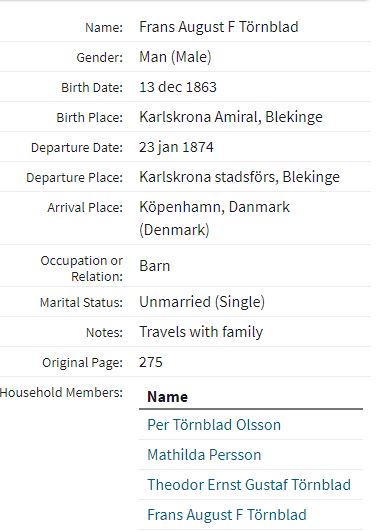
When Sonja Greta Thornbladh was born on June 25, 1929, in Ohio, her father, Nils Magnus Thornbladh, was 32, and her mother, Maragret (Thomae), was 28. Her older brother was Robert Nelson Thornbladh (1925-2004).
Sonja married George Russell Harris in 1950 in Cuyahoga, Ohio.
(please note that in the above certificate of marriage the Maiden Name of Mother is listed as Margaret Thomas – actually should be Margaret Thomae)
In 1955, Sonja and George had a son, Todd George Harris. At the age of 24, Todd married Thereasa Probst.
Sonja was 45 years old at the time her mother, Maragret passed away on April 14, 1975, in Fort Pierce, Florida, at the age of 73. When Sonja was 50 years old, her father Nils Magnus Thornbladh, passed away on April 28, 1980, in Fort Pierce, Florida, at the age of 83.
Sonja was divorced on January 9, 2004, when she was 74 years old. The grounds for divorce were “gross neglect of duty.”
1945/1946 photos of the U.S.S. Oregon City (heavy cruiser) and of the shakedown at the Guantanamo Bay Naval Reserve. All photos below were scanned from print copies owned by Robert Hess who served as an Ensign.
Robert L. Hess, my father, was an Ensign on the U.S.S. Oregon City. In this blog, I share pictures that I scanned from a photo collection that my father owned. I believe that some of these photos were taken by my father. It is possible that he also obtained some of these photographs from another unknown source/person. Enjoy this glimpse into history on the U.S.S. OREGON CITY and also the photos taken at their 1945/1946 shake down at Guantanamo Bay Naval Reserve.
The Oregon City sailed from Boston on 31 March 1946 for shakedown at the Naval base on Guantanamo Bay, then returned to Boston in mid-May. The photos from my father’s collection that were taken at Guantanamo Bay are all captioned “April-May 1946.”
My father, Robert L. Hess, enlisted in the U.S. Navy’s pre-officer training (V-12) while he was still in High School in Benton Harbor, MI. He entered into active service on 1 July 1943 and was assigned to the University of Michigan where he earned two B.S.E. degrees from the Engineering College in 1945. He was then assigned to the Midshipman program at Columbia University. He was commissioned as an Ensign in October of 1945. He married my mother, Gretchen Ream Hess, in Ann Arbor on 15 December 1945.
He was assigned to the USNRMS (United States Naval Reserve Midshipman’s School), at Columbia in New York where he took his officer training.
During his Naval career, he served on the USS Oregon City (CA-122), the USS Kula Gulf (CVE-108) and the USS Manila Bay (CVE-61.)
Subject: Robert L. Hess’s History of Research, Service and Teaching Contributions to the University of Michigan.
In 1945, Professor Hess received two B.S.E. degrees from the University of Michigan in less than a 3 year period, one in Engineering Mathematics and the other in Engineering Mechanics after which he served as an Engineering Officer in the U.S. Navy.Hess served as junior Division officer, main engines division, on a heavy cruiser at sea and later as auxiliary Division officer on a pair of light escort carriers.
Upon release from active World War II service he returned to Ann Arbor, the homeof his wife, Gretchen R. (REAM) Hess. On a visit to the Engineering Mechanics office he was hired as a full-time Instructor and was asked to undertake a research project by Prof. J. Ormandroyd. The project became the basis of his Doctorial Thesis, “The Dynamics of Ship’s Structures, including Shear Deformations”. This work was directed by Professor Ormandroyd and became one of the first major engineering works to be programmed for the ENIAC (that being done by the David Taylor Model Basin, Dept. of the Navy). During the three years of full time teaching as an Instructor, (Dr.) Hess served in the U.S. Naval Ready Reserve and spent his training periods at the Model Basin. He was honored by being requested to provide 40 hours of lectures at the Model Basin on advanced mathematics and dynamics for the scientific staff of the U.S. Navy when he was 24 years old.
Professor Hess was recruited by the Bell Telephone Laboratories and joined BTL, upon completion of his doctorate, as a Member of the Technical Staff in the fall of 1949, being assigned to a ‘heavy-tube’ Development Group. The many research projects he participated in included the assignment to undertake the development of a pilot line for the production of both the material for and the devices known as ‘point-contact’, type A transistors.(This was before the courts ordered BTL to place the technology on the market and was thus a unique endeavor for Dr. Hess upon which several of the newly licensed companies partly based their developments.) It was typical of him to have the breadth of both interest and scientific knowledge that brought him such a coveted assignment and also success in it. He developed new techniques of crystal growing and zone-purifying as well as a novel method of doping the contact area using microwave techniques to created photo-sensitive transistors.
In his third year at BTL Dean G.G. Brown called him with an unsolicited invitation to return to the U. of M. as an Assistant Prof. of Chemical and Metallurgical Eng. and Assistant Professor of Engineering Mechanics and to also take on a Phoenix Project dealing with the atomic structure of glass. Dean Brown gave Prof. Hess the challenge of creating a new course in structure of glass and ceramics. At the end of his third year Hess was promoted to Associate Professor of Engineering Mechanics and left the Chem. Met. Dept. He undertook the reactivation of the Engineering Mechanics Department’s Photo-Elasticity Lab. and generated a course for it as well as teaching in the areas of elasticity and dynamics.
In about 1957, Vice President and Dean of Faculties, Prof. M. Niehus asked Prof. Hess to join an elite committee of engineers and scientists to oversee the work of the Willow Run Laboratories which at that time was experiencing troubled relationships with the Department of the Army, its prime source of support. In Jan. 1958 Dean Niehuss requested that Hess take leave of his teaching and consulting practice and join a new management team, headed by Prof. J.A. Boyd (now Chairman of Harris Corp.) to salvage and redirect the Willow Run Laboratories. Hess was given the specific assignment of Technical Director of Project Michigan, a 4 to $6 million/year program, as well as an Assistant Directorship of WRL. In addition Hess became the Head of the Applied Research Group of the Labs, which at that time had just demonstrated the MASER and a year prior to the demonstration of the Ruby LASER. Hess was instrumental in extending optical data processing to the field of automatic photo-interpretation. In March of 1958 Dean Attwood informed Hess of the approval of his promotion to full Professorship. ( A promotion which was said to make Hess the youngest full professor in the College’s history up to that time.)
Prof. Hess soon developed a keen ability to manage multiple teams of researchers on topics varying from Information processing, semiconductor development, infrared scanning and synthetic antenna radar. He was able to apply his knowledge of basic physics and mathematics to the tasks as a member of the research teams and also represented them to general officers representing the U. S. Army, and, upon the creation of a Department of Defense to the scientific part of that community. In his unique fashion and with unusual modesty, his term of management, which after three years included the project directorship as well as its technical direction, Hess always put his staff in the foreground and sacrificed personal fame in the process. Never-the-less upon his decision to return to teaching, the Department of the Army awarded Prof. Hess with THE OUTSTANDING CIVILIAN SERVICE AWARD and METAL the inscription of which read in part ‘Hess succeeded in establishing and maintaining the University of Michigan as the leading free world authority in surveillance technology. His own proven scientific talent and professional imagination contributed additionally to the accomplishments of a broad team of scientists and technicians. The rare combination of skill, foresight and devotion to country….’.
During the years of 1964 and 1965, Hess served as the personal representative of the U.S. Army’s Assist. Chief of Staff for Intelligence and led teams of scientists though a comprehensive field review of the Army’s Combat Surveillance capabilities both in Europe and in Korea. The Army implemented over 70% of his technical recommendations for the Korean area. In 1965 Professor Hess visited with President H. Hatcher with the view of leaving the Project Michigan assignment and returning to full-time teaching. By that time, the I.S.T. had been created and W.R.L. was part of it and Hess was one of its Directors. President Hatcher, through Prof. Norman, Vice President for Research offered Hess the challenge of using the $10 million original gift from the automobile industry to create the Highway Safety Research Institute. This was a special honor as that gift was reported to have been the largest gift in the University’s history at that time. Upon acceptance, Hess hired a top level ‘internal administrator’ for H.S.R.I. and thus was able to devote his attention to building the staff and its research programs and also to return to teaching which was his first love. With a Regent ally appointed Executive Committee and with the cooperation of dozens of the University’s faculty Hess was able in a few years to build a facility, hire internationally known figures and to build a program of research spanning fields from Law to Medicine and from Engineering to Psychology. His untiring drive established the Institute as the world’ premier institution of its kind and brought not only many millions of research dollars to our campus for the support of researchers, faculty, and graduate students but also enhanced the reputation of the University of Michigan.
During his tenure at H.S.R.I., Hess served as a consultant to the Army’ Science Board where he both chaired and participated in the study of many of the nation’s outstanding technical problems and challenges.
Professor Hess personally undertook two major research studies while teaching a nearly full load and directing the H.S.R.I. These were the review of the complete research findings in the scientific, engineering and medical communities of the experimentation protocols and the same for the area of blunt trauma to the human head and the same for the area of blunt trauma the thorax. In each case an annotated history of the development of the use of the knowledge in regulation was developed and recommendations were made for future research in the fields. The second of these studies was selected for publication in the S.A.E.’ transactions. Hess served the University by membership on President Nixon’s Highway Safety Advisory Committee and also undertook several overseas services as a Consultant to the Wor1d Hea1th Organization.
Prof Hess resigned his position as Director of U.M.T.R.I. (the successor to H.S.R.I.) and returned to a full time faculty teaching role in January of 1984. Shortly thereafter Hess founded a computer software company, HCCI, which deals in engineering specialty software for a international audience in the forensic engineering area. In keeping with his reputation, he has undertaken the teaching of the Control Systems course, ME461, a new course for him, with vigor and has provided new leadership in its laboratory and course work with several software packages he has written to enhance the depth and breath of the educational experience of the students. These include programs dealing with Fourier techniques, general integration methods, data plotting, frequency analysis, root locus, Nyquist techniques, Myk1lestad and Holzer techniques, matrix iteration techniques, eigenvalue/eigenvector techniques and many others. He also accepted an assignment as the Mechanical Engineering Program Advisor and has written degree-audit software packages now used by the Mechanical Engineering and Applied Mechanics department. The implementation of modern techniques allows Professor Hess, as the Advisor, to take a proactive rather than a reactive role in counseling. Similar HCCI software is now being installed in a large engineering college.
Professor Hess’s academic and service accomplishments are outstanding and the respect that he has gained from his peers is only reflective of the credit he has given to them over a total of 37 years of devoted service to the University. In the Pentagon, corporate offices, the classroom and laboratory he has represented the best the University of Michigan could offer its students and country.
HERE ARE MY REFLECTIONS AND FINDINGS ON EDWARD HIGBEE – 8TH GREAT GRANDFATHER
As with several of my other blogs, I continue to ponder that a majority of my direct ancestors (and 53% of my DNA) are from Great Britain. Edward Higbee, the subject of this blog, is from my father’s side of the family. Until the recent past, I had not known much about the extended side of my father’s family or his connection to Great Britain heritage. Instead, I had based my beliefs about the nationality of my ancestors only on my mother’s side of the family. I had ALWAYS identified myself as being of German descent. In my generation of baby boomers, it was common to be asked where your family immigrated from and I always gave the same answer, “Germany!” I only mention this point, because it is quite a process to try to redefine thoughts of MYSELF! There have been many “eye-opening” experiences since I became fully immersed in genealogy research. I have started to “unpack” stories that are in a very real sense my own. The information for the story of my 8th great grandfather has been helped by the fact that his life has been carefully and diligently researched by many genealogists.
Edward Higbee, my 8th great grandfather, was from Ivinghoe, Buckinghamshire, England. He was born on 2 February 1616. (I think this is quite a nice birthday for an 8th Great Grandfather as it is also one of my favorite holidays- Ground Hog’s Day).
Edward’s father was John Higbed (note the variation of spelling) and his mother was Ursula Blacknell.
“Edward Higby was born of yeoman stock, and probably grew to manhood in the parish of Ivinghoe. His father was altogether likely a tenant farmer, holding his land under the lord of the manor by copyhold. This method of holding land had become by this time similar to our estates in fee simple. The farmers of Ivinghoe sent their cattle and farm products to the London market. The beef cattle were driven to London the same as the farmers here drove their cattle to market one hundred years ago. Some of the Higbys dealt in cattle, and one was a butcher in London; and young men of this section went down to London for employment. The section in which the Higbys lived, about twenty miles wide, extended to within about fifteen miles of London; and now all this country up nearly as far as Ivinghoe, being in part hilly and wooded, is the playground of London.”
As an aside, many of our ancestors would have homes located close to London or in London.
Edward Higbee “crossed the pond” and immigrated to America. He settled in Pequot Harbor, Connecticut in approximately 1646. He would have been a very young man of 29 years at that time. In 1650, he moved and lived in Stratford, Connecticut,and was one of the early colonists who settled in that area. Life was often hard for these early colonists. Edward did not stay in Stratford long. He and his father-in-law had become active in trading and this occupation frequently took them to Long Island (at this time, Long Island was also a part of Connecticut.) Edward would become a resident of Long Island. I understand his trading among other things was in rum business. In 1659 Edward did not return from one of his trading expeditions. It was feared that he had been lost at sea.
There are some great stories about his final return from that trip after a lenghthy absence. Imagine my surprise to find out that Edward was actually arrested for running towards his wife and kissing her which was against the law to do on the Sabbath! He had to pay a fine for this action! But, he did live in Connecticut at a time when people in colonial New England were subject to laws limiting what they could do on Sunday. These laws were commonly known as the blue laws.
By 1664, Edward had purchased land in Middletown. The land purchase includes a deed from Scankeet (native American Indian). The deed is referenced in the book link that I provided at the beginning of this blog.
Edward married 2 times. He first married Jedidah Skidmore in Queens, New York, in 1648 when he was 32 years old. His wife Jedidah passed away on October 17, 1660, in Livingston, New York, at the age of 36. They had been married 12 years.
At the age of 46, Edward took his second wife Lydia Smith. Lydia was 19 years old when they were married. The age difference is startling to me in my present day culture! It was from this 2nd marriage that my family line continues with the birth of my 7th great grandfather, Samuel Higbee.
Lydia would only live to the age of 40. Edward died at the age of 83 years old.
Henry Joseph Spruhan (1857 – 1939)great-grandfather
Henrietta Spruhan (1894 – 1984) grandmother
daughter of Henry Joseph Spruhan
Robert Lawrence Hess (1924 – 2017)father
son of Henrietta Spruhan
Linda Claire Hess (1954-)
I am the daughter of Robert Lawrence Hess
HIS FATHER DIED
At 12 years old Henry Denny Spruhan (he would later change his middle name to Joseph) was an orphan. According to the notes of a Spruhan family genealogist, Lydia Spruhan, Henry was taken in by the VanCleave Family of Crawfordsville, Montgomery County, Indiana. Henry’s parents had both immigrated from Ireland and Mrs. VanCleave who took him in had also been born in Ireland, while her husband had been born in Indiana.
Henry Spruhan is shown living with the Vancleave family when he was 12 years old.
Henry was born 3 November 1857 in Crawfordsville, Indiana. His mother was Margaret Denny from Kilkenny, Ireland. She died early. I am unable to trace her records. His father, Garret Spruhan, had been born ABT. 1825 also in Kilkenny.
After Henry’s father died, his father remarried, but had no children from his second marriage.
Both of Henry’s parents were Catholic and baptized their children in Crawfordsville at the Catholic church there. Henry was one of 5 children born to Garret and Margaret.
Sadly, Henry and his siblings would go to separate homes after the death of their father. Only Macie, the youngest, would remain on the farm with her step-mother. Such a heart breaking experience for anyone, especially a boy of only 12. Apparently, Henry and an older brother each received an inheritance of real estate valued at $360.00. The exact details of this inheritance are still unknown and many have questioned how it came about. It is presumed that it was from his father and a step-mother, Ann McKerrit Spruhan. The farm, after all, had been successful and must have had the means to provide such an inheritance.
HENRY’S FATHER- GARRET SPRUHAN
The Spruhan families had been in Ireland for many 100’s of years. Burials of the Spruhan family had taken place in the area of the Ancient Celtic Kings, near the Black River in Kilkenny, Ireland.
Henry’s father, Garret Spruhan, had arrived in America in 1839, long before Henry was born. Before coming to America, Garret had been a farmer in Kilkenny, Ireland. Tax records for Indiana show that he operated a successful farm in the states.
Once Garret (Henry’s father) arrived in America, the railroads, would later allow him to move west and settle in Indiana.
Garret married Henry’s mother in 1852. They were wed in Hamilton County in the state of Ohio. The marriage was presided by the Arch Bishop.
HENRY’S LIFE (this section of my blog is what I learned about Henry from my father Robert L. Hess)
Henry was my great grandfather –the father of my paternal grandmother Henrietta Spruhan Hess.
I have only minor memories of discussing Henry with my father. My father told that Henry had worked as a broker in the stock market. (Of course, the stock market would crash in 1929.) Recently, I felt curious about Henry, a Great Grandfather that I never heard much about. Now, I am older and have time to begin to trace his story. In the end, after many hours of research, I have more questions than answers.
My father once told me that my Grandmother, Henrietta Spruhan, contracted polio and blamed her parents for that. Her parents (Henry was her father) had been taken her to a hospital to visit a sick relative. It was soon after this visit that Henrietta contracted polio and she thought her parents should not have put her in this position. She would carry some of the hardship of this disease and some resentments through the rest of her life. (It is only recently that I have wondered how this story played out from the perspective of her father Henry. How had he suffered from guilt and pain while worrying about a daughter with a terrible disease?)
My father also told me that Henrietta had a privileged childhood. Her father, Henry Josesph Spruhan, had been successful in his career as stock broker. Henrietta, was a true socialite! This was both good and bad. Of course it was nice that she had a wonderful education and opportunities to learn and excel at playing the piano, etc. She was a college graduate. Census records even indicate that they had live-in help. On the other hand, my grandmother’s life would be VERY difficult when she had to transition from socialite to living on a farm – an apple orchard in Michigan later in her life. But, that is a different story.
HENRY’S LIFE continued…
Although Henry would begin life in Crawfordsville, Indiana, he would go on to live in New York and Chicago for much of his adult life.
I do not have any answers for that time between his being taken in by a local family, to the time of his rise professionally in the world of finance. He was successful in his own right, but he married into a very rich and educated family. Henry’s wife was Caroline “Carrie” Baur. Carrie was the daughter of John Jacob Baur who had run a large retail drug pharmacy. Carrie’s brother would work in the family pharmacy and go on to be the perfecter of liquid carbon acid (carbonation). There are MANY historical accounts of the Baur family.
Henry’s wife Carrie was born in
One of the first records that I reviewed to gather information were the 1860 census. In this census, Henry is 2 years old. I am not sure why, but his name in this census is listed as “William Henry”. His parents both list place of birth as Ireland. All of the children were born in Indiana.
Here, in the photo of the 1870 census , you can see that Henry has been taken in by the VanCleave family. Henry is 12 years old.
1870 census…see printed version below. This shows that Henry is living with the Vancleave family by age 12.1870 census- Henry has been taken in by the Vancleave family
In the 1880 census he is a boarder and keeps books in the R.R. office – Perry Township, City of Colfax, Indiana. He is 22 years old.
In an 1887 Terre Haute, Indiana Directory the listing states: Spruhan, Henry J clk (clerk?) McKeen and Co., res. 620 Deming
In an 1899 news article in the Chicago Tribune, it looks like Henry is part of a fancy reception. (Note: I often see his name in print as “H. J. Spruhan”, once I figured this out, it was easier to find matching articles!
The next information is from the 1900 census from Cook County Chicago. Henry is 42 years old. He says both his parents were born in Ireland. He is a broker. He lists his birthday as 1858. Henry’s wife Carrie says her father is from Switzerland and her mother from Germany. Carrie’s birth is October 1863. In addition to their children, Garret, Henrietta and Josephine, there is also living an 18 year old female servant born in September of 1881.
Here is an article from 1902: Henry J. Spruhan from Chicago, IL 10 Jan 1902
In a New York city directory from 1903, the listing is as printed under Manhattan and Bronx Brokers, NY, NY Spruhan, Henry J. 60 Bway (Broadway?) In the1906 New York city directory, the listing as just the same as 1903.
Henry and his family are listed in the New York 1905 census.
1910 census from Hoboken, NJ. He is now 51 years old. His wife Carrie is 44 years old. She states she has had 4 births and 3 now living. He now says name is Henry J. Spruhan and his father was born in Ireland and his mother in Scotland? Occupation is broker. Carrie states her place of birth is Kentucky (not what I have in her records) and her father’s birth was in Switzerland and her mother from Germany. Garret D. is now 18 and living with them. He says his father’s birth was in Indiana and his mother’s birth was Kentucky. Looks like they lived at 606 River Street. Also listed are Henrietta, age 16 and Josephine, age 9.
In the 1920 census from Cook County, Chicago, IL., Henry and his family is on 5542 West Adams Street (rented) He is now 60 years old. His occupation is listed as a salesman for a Hardware company. Carrie is 47 years old. Henrietta (my grandmother) is 26 and living with them and has an occupation as operator of a Dictaphone at a hardware company. Josephine their youngest daughter is 19 years old and a University student.
In a 1922 Oak Park Directory Spruhan, Henry J (Carrie B) com trav. Residence at 107 S. Maple Ave.
In a 1923 Oak Park Directory Spruhan, Henry J (Carrie B) salesman. Residence at 107 S. Maple Ave.
Here is a news ad from 1926: Spruhan 14 Nov. 1926 Chicago Tribune for sale
In a 1930 Oak Park Directory Spruhan, Henry J (Carrie B) real estate, 108 S. Harlem, Residence at 107 S. Maple Ave.
Here are NEW items to add to this story…
Below…from Kansas City Gazette in 26 January 1914
From 12 December 1909, The Washington Post…see below
Here are some handwritten notes from my father Robert Lawrence Hess about his grandfather:
I believe this is a photo of Henry and Carrie Baur Spruhan. The caption on the photo says: “Father, Mother and Mollie.”