Tag Archives: fiction

The Secret in the Hidden Wing: A Family Mystery from the 1970s

In this story, I recount an experience that actually took place during my college years…

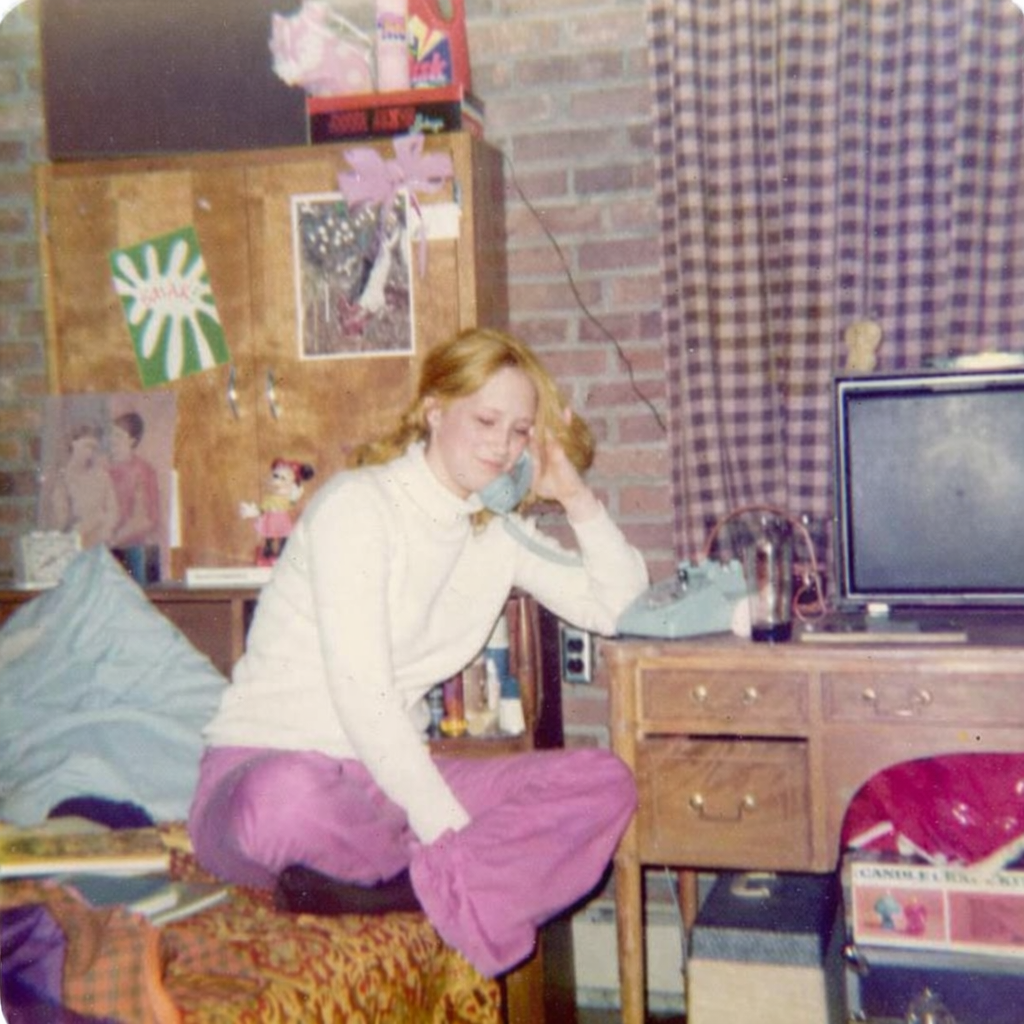
The garage had been renovated into a large bedroom in the estate where I lived during college. Circa 1974

During my college days, I lived with twelve other young women in a mansion. We were thirteen female students selected to reside in a large estate owned by the college we attended.

The house itself felt like something out of a novel. There were hidden passages, rooms tucked unexpectedly off stair landings, and exceptional antiques that seemed to hold secrets of their own. Even now, late in my life, I still dream about those spaces.

The large living room could comfortably seat all thirteen of us around a television. We never attempted to light the grand fireplace, nor did we decorate the expansive marble mantel. Yet behind that fireplace wall was one of the home’s most intriguing secrets — a hidden wing. What looked like a simple broom closet door opened into a concealed hallway. In that quiet passage were two bedrooms and a large bathroom, one of several in the house. My friend Mayumi lived in one of these “hidden” bedrooms.

All thirteen of us young women got along famously. One woman, Jane, became known for organizing elegant little socials. She would appear with delicious food and hot toddies on cold winter evenings. We studied hard, but when Jane called out that a gathering was ready, we dropped our books and came together like a close-knit family — talking, laughing, and dreaming aloud about our futures.

Before school holidays or semester breaks, we hugged one another and promised to return with treats to share. Among us, Mayumi was the quietest and perhaps the sweetest. She carried herself with gentle hospitality and never sought the center of attention. She drank sparingly, spoke softly, and brought no drama into our lives.

When she left for one particular holiday break, she seemed happy and lighthearted.

But when we returned to the estate afterward, Mayumi was different.

She did not gather with us to exchange stories of home. She declined even Jane’s warm invitations for cocktails and sweets. We usually paused our busy study schedules to watch a soap opera together, but Mayumi no longer joined us for that ritual either.

One evening, I walked down the hidden hallway toward her room. I needed to know what was troubling this woman who had always seemed so serene. I found her sitting on her bed, crying quietly.

“Mayumi? What’s wrong? You can tell me.” I sat beside her and placed my hand gently on her back.

She looked up at me with eyes full of pain and said something so unexpected that, at first, I thought I had misheard her.

“My sister is my mother.”

I stared, confused.

Mayumi dabbed at her tears with a handkerchief and began to explain. Her mother had been very young and unmarried when she became pregnant with Mayumi. To avoid family disgrace, her grandmother devised a plan. The grandmother would pretend to be the expectant mother. Mayumi’s real mother was sent away until the baby was born, while her grandmother wore a pillow under her clothes and staged a pregnancy for the community to see.

I did not know what to say at first. The hidden hallway suddenly felt heavier, as though the walls themselves were holding their breath.

Mayumi continued softly. She had grown up calling her grandmother “Mother” and her biological mother “Sister.” It was not until she was older that she learned the truth. The holiday break had forced her back into that complicated arrangement — back into the house where roles were still performed, where no one spoke openly about what everyone knew.

In that grand mansion full of secrets and hidden doors, it seemed fitting that one of us carried a secret of her own. But this was no charming architectural mystery. It was a life rearranged to protect reputation, a story rewritten so others could feel comfortable.

I remember sitting beside her on that narrow bed in the hidden wing, thinking how strange it was that the quietest among us carried the heaviest story.

In the days that followed, Mayumi slowly began to rejoin us. She did not tell the others. That confidence stayed between us, tucked away like the concealed hallway behind the fireplace.

Looking back now, I think that mansion shaped us all in different ways. We were thirteen young women learning about ambition, independence, and friendship. But that winter, I learned something else: families are often built on stories — and sometimes those stories are crafted for survival.

Even now, when I dream of that house with its hidden passages and antique rooms, I think of Mayumi. I think of how secrets can live behind walls and inside hearts.

Red Hood – a 1996 short fairy tale by Linda Claire Groshans

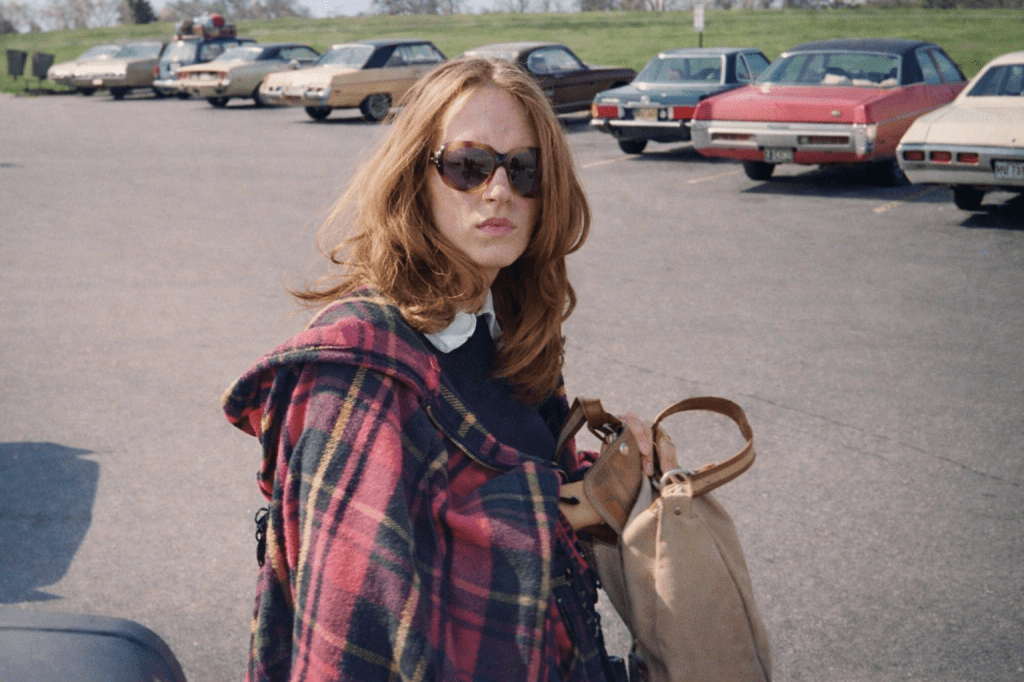
A photo of me in my red cape in the 1970’s when I was in my 20’s

My name is Red Hood. Okay, you probably remember me as Little Red Riding Hood, but that name is no longer fitting because I am now 42 years old.

I have recently completed years of therapy to help me cope with the traumatic childhood incident involving the so-called Big Bad Wolf—whose trickery nearly cost me my life. Those years of therapy, along with my husband’s understanding, have given me the strength I needed to speak publicly about how my life has turned out.

I’m sure you know my dreadful case. There are countless books printed about the nightmare event of my childhood. Sadly, I have made no money from any of these publications and have instead been 100 percent exploited. I find it deeply repulsive that illustrated children’s storybooks exist about this event. How horrifying is that? A lawyer is currently working on my behalf to rightfully secure some of the proceeds from the books and movies that monetized my trauma while leaving me to struggle financially.

Money is rather sparse these days, which is why I’ve agreed to write this article. At last, I will receive some financial compensation. I am also under contract for an upcoming docudrama, in which my husband will be featured as well.

I remain an object of curiosity. People always want to know what became of me. So let me offer you a glimpse into my current life.

I am now a middle-aged woman, and I still live in the woods. My legal name was officially changed from Little Red Riding Hood to Red Hood on my twentieth birthday. In her will, my grandmother left me her small cottage. Before moving in, I hired a security company to install high-tech security systems and cameras. I take no chances.

You may recognize the familiar illustrations of me at age ten, with blonde curls and a red hooded cloak. I grew into a fairly attractive woman. My hair has dulled over the years, so I use professional products to dye it a youthful golden blonde. I’m of average height. My wardrobe includes many colors, though I admit I still have a weakness for the color that shares my name: red.

I no longer wear a cape—it’s a terribly impractical garment. My favorite piece of clothing is a red hoodie with a front zipper and deep pockets. Appearance has always mattered to me. I pay attention to what suits me best, and I’ve discovered that my legs look especially nice in heels. I hate to admit it, but I’ve indulged in the purchase of many pairs of striking red high heels. You might say I’ve perfected the art of walking in them. My husband claims this is pure vanity, but he smiles and winks whenever I show him a new pair.

I had several relationships, but marriage never crossed my mind until I met someone who truly understood childhood trauma. My husband is the brother of my close friend Gretel. His name is Hansel. Hansel and I are both proud of ourselves for overcoming deeply painful experiences. Like my story, Hansel and Gretel’s lives have also been turned into storybooks.

Hansel appreciates my decorating style. He wanted nothing to do with a home that resembled a stereotypical gingerbread house. Recently, we had a photographer take a portrait of us in our cozy cottage. Hansel looks handsome in his lederhosen, and I look lovely in a form-fitting red dress paired with my red heels.

But appearances only matter so much. What truly defines us is the advocacy work Hansel and I support. As victims of crime and as children whose lives were exploited for profit, we are deeply involved in legal efforts to protect other children. Hansel holds a law degree, and his firm specializes in—and actively tries—these cases. You may have seen his firm’s advertisements on television: the ones celebrating victories on behalf of Jack (also known as Jack of Beanstalk fame) and Pinocchio, who is, in fact, a real boy.

Sadly, we did not prevail in the highly publicized trial on behalf of Peter Pan. Hansel hopes to appeal the decision. These cases have severely depleted our limited financial resources—but the work is vital.

That is why we ask for your help.

First, please stop telling children about our misfortunes as though they are harmless bedtime entertainment. We are real people with real pain.

Second, we urge you to donate to the Red Hood Foundation. Your contribution is tax-deductible and will help us continue to litigate and win cases that protect children. For every $500 donation, you will receive a red hoodie from us. For a $100 donation, you will receive a red coffee mug featuring our photograph.

Show that you care about children. Donate generously.

After all, we are fighting for every child’s chance to live happily ever after. We long for a world free of monsters—whether they are wolves in disguise, giants who smell the blood of Englishmen, or witches who lure children with candy so they can eat them.

Help us stop these atrocities.

Thank you for your support.

Disclaimer: Only 10% of donated funds will be used to purchase fashion items such as my red hoodies.

An Out of This World Date by Linda Claire Groshans – surprise…it is a mostly true story of a dating experience I had after my divorce!

Photo was taken 20 years ago when this experience happened!

I had been using an online dating site long enough to know how to protect my identity. Before meeting anyone in person, I always asked for the man’s phone number and never gave him mine unless I was extremely interested after a successful date. I used only my first name. I never shared my home address or place of work. I was prepared. I was secure.

So when a gentleman on the dating site sent me a message saying he had read my profile and seen my photo—and hoped we might get to know one another—I was flattered and a little surprised. He mentioned that he noticed I was a teacher and said he was sure I had a lot I could teach him. I found the comment slightly suggestive, but also clever and witty.

I had been asked out plenty of times before, but this man seemed exceptional. He was beyond handsome—perfect, really. Picture a Greek god and you’ll have a fairly accurate idea of his appearance. He was impeccably groomed, and in his profile photo he wore a striking black shirt and black tie. I suppose you could say I was smitten.

We arranged to meet at Panera for coffee. He was a complete gentleman.

“Hello, Linda,” he said, his voice deeply masculine and romantic. “I recognized you instantly from your photo.”

“Hello, Harlan,” I replied. Yes—his name was Harlan, and I liked it immediately.

“May I get you a coffee drink or anything else?” he asked.

I requested a vanilla latte, and he suggested I wait for him at a nearby café table. As I sat down, I used my compact mirror to make sure I looked my absolute best. This man was amazing. There was an aura around him—people smiled at him, nodded as he passed. Magnetic, I thought to myself.

Still, I reminded myself, I was his date. I was the focus of this meeting. I couldn’t wait to learn why he had invited me and what he wanted to know about me.

He returned, sat close, and handed me my drink.
“Careful,” he said. “There’s a warning label on the cup.”

“A warning label?” I asked.

“Yes,” he said, pointing to the tiny print explaining that the contents might be hot.

I was even more impressed. How attentive. How thoughtful.

After a few quiet moments of gazing into his mesmerizing eyes, I asked him what he wanted to know about me.

“I am ready to scan any information you would like to provide,” he said. “It will be useful for my knowledge base.”

His voice was silky—like a late-night radio host on Pillow Talk. I realized he could say absolutely anything and it would sound like the most fascinating conversation of my life.

I giggled and began. “Well, I live in a nice home not far from here. I have two cats.”

I was about to continue when he reached across the table and took my hand.

“Tell me about cats,” he said.

“Oh—my cats?” I asked, making a mental note that this man must be a serious cat lover.

He nodded affirmatively, so I told him about them: one black, one orange. “Halloween colors,” I said.

“Do you have pets?” I asked.

Still holding my hand, he said that physical contact helped him learn more about me. I felt flattered again. His hand was warm and steady, his gaze intense.

“Affirmative,” he said.

I blinked. “What?”

“Affirmative. I do have pets,” he clarified.

“Cats?” I asked.

“Yes,” he said carefully, “they are… a sort of cat.”

“What color are your cats?” I asked.

He hesitated, visibly thrown off. “I don’t know how to answer that question.”

“I just wondered what color they are,” I persisted.

“I must explain,” he said. “I do not perceive color the same way you do.”

“Oh,” I smiled. “You’re colorblind.”

I decided that even the perfect man could have one small imperfection.

The rest of the conversation was odd—strange pauses, unusual phrasing—but I didn’t care. I was in love with Harlan. Oddness seemed trivial. Perhaps he was just nervous, I told myself.

After about an hour, we agreed to end the date with hopes of meeting again soon.

Outside the café, he asked if he could kiss me. I was surprised—this wasn’t something I usually did on a first date, especially not at the entrance of a Panera—but I couldn’t wait for him to kiss me.

He leaned in and whispered, “Now you will understand me.”

Oh, I wanted to understand him. I wanted to elope that very day.

We kissed.

My feet felt as if they lifted off the pavement. Swirls of color surrounded me. Warmth spread through my entire being. I felt safe, adored, and deeply desired.

When I blinked, I saw him clearly: Harlan was a creature who slightly resembled a tabby cat—large, gentle, loyal. And somehow, this made perfect sense.

He broke the kiss and looked sad. Holding both my hands, he gazed into my eyes. I understood then that we would not have another date. He would not be on planet Earth much longer.

I read his thoughts easily. He was grateful. He loved me. He had learned from me. He promised to wish me only the best. And though he had to leave, he wanted me to know that my information about cats had been very useful.

When I blinked again, he was gone.

I have never had a kiss like that since.

Now, I only bother to look at dating profiles of exceptionally gorgeous men dressed entirely in black—especially those who are eager to learn.

Tell me a story about wallpaper!

I encourage you to take a moment to share photos or memories of wallpaper that once claimed precious wall real estate in your homes. It’s such a fun topic—and almost everyone seems to have a story to tell.

Wallpaper actually began as a luxury, created in medieval times as a substitute for costly wall tapestries. By the 18th and 19th centuries, printing advances made wallpaper more affordable and accessible across social classes. It reached peak popularity during the Victorian era—though unfortunately, this was also when many wallpapers contained arsenic. Yikes. Because people didn’t yet understand the dangers, the resulting illnesses were often blamed on “bad air.”

I’ve been using Google search within my Google Photos albums to track down pieces of our own family wallpaper history, and it’s been a surprisingly delightful trip down memory lane. I hope you’ll share photos too! Tell me about the wallpaper you loved… or the patterns you couldn’t wait to see disappear.

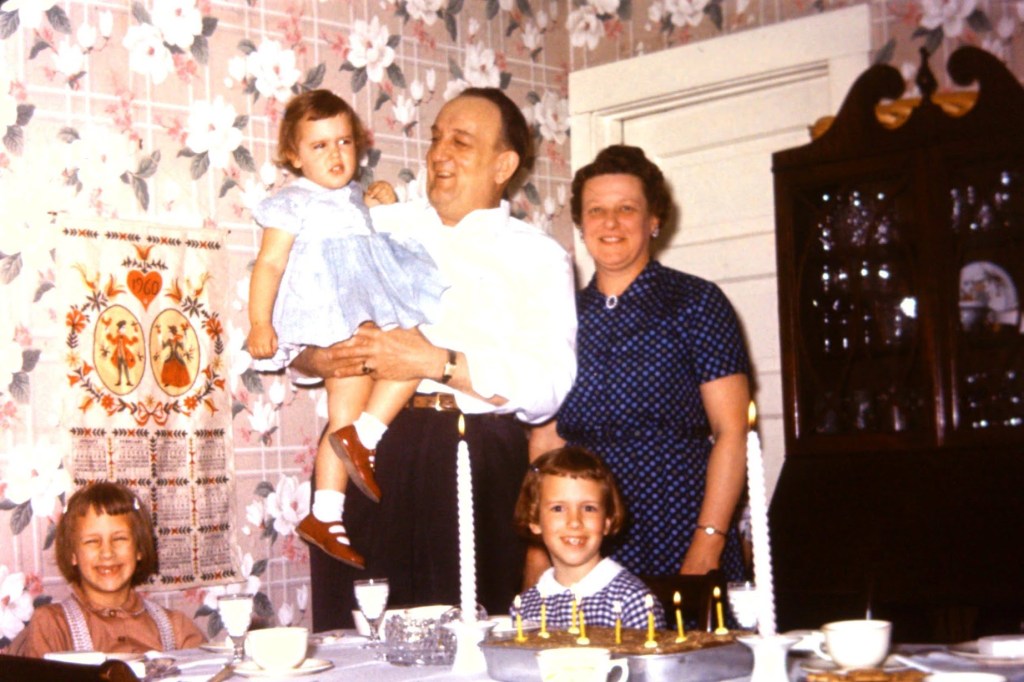
Linda Claire, Kathryn, Edward Klotz “Bones”, Madalyn Klotz and Mary Ann in March 1960 at the Klotz home on North Main Street, Ann Arbor, MI.
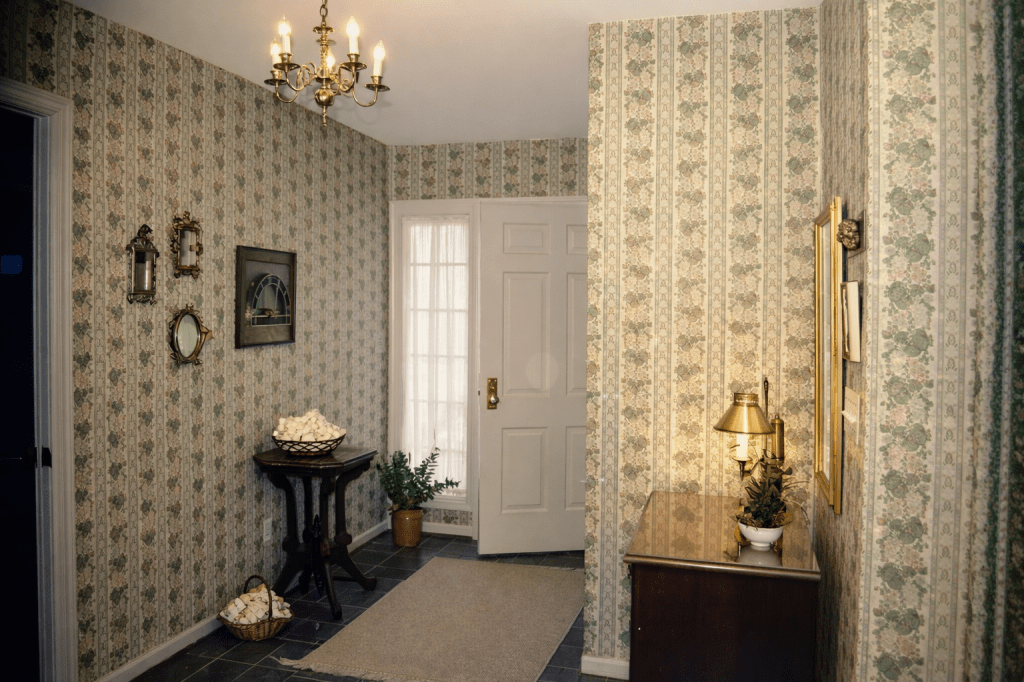
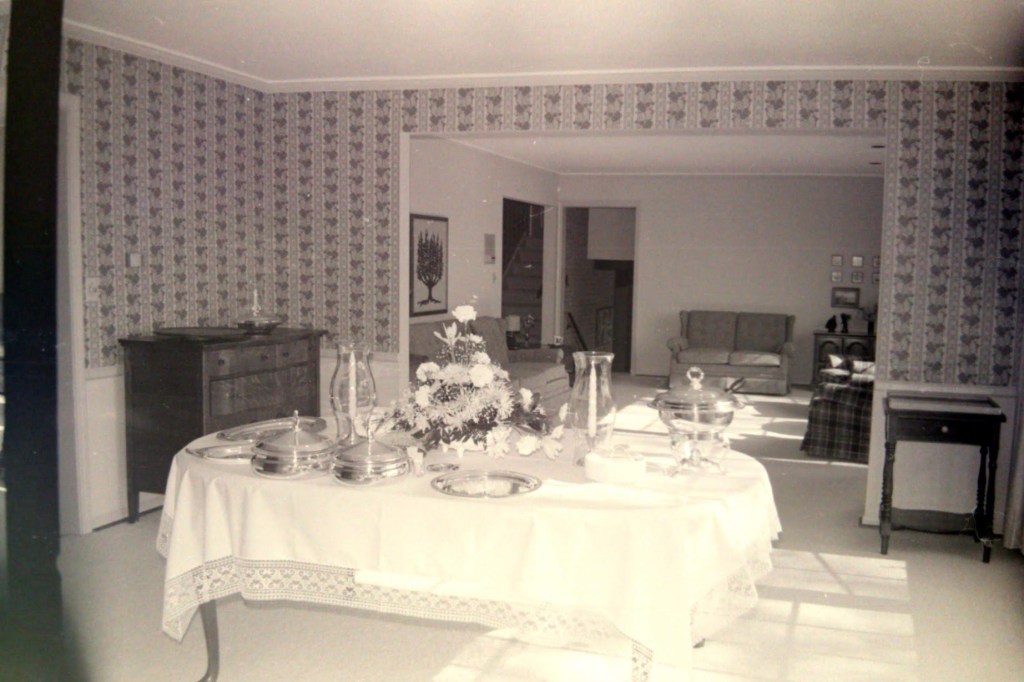
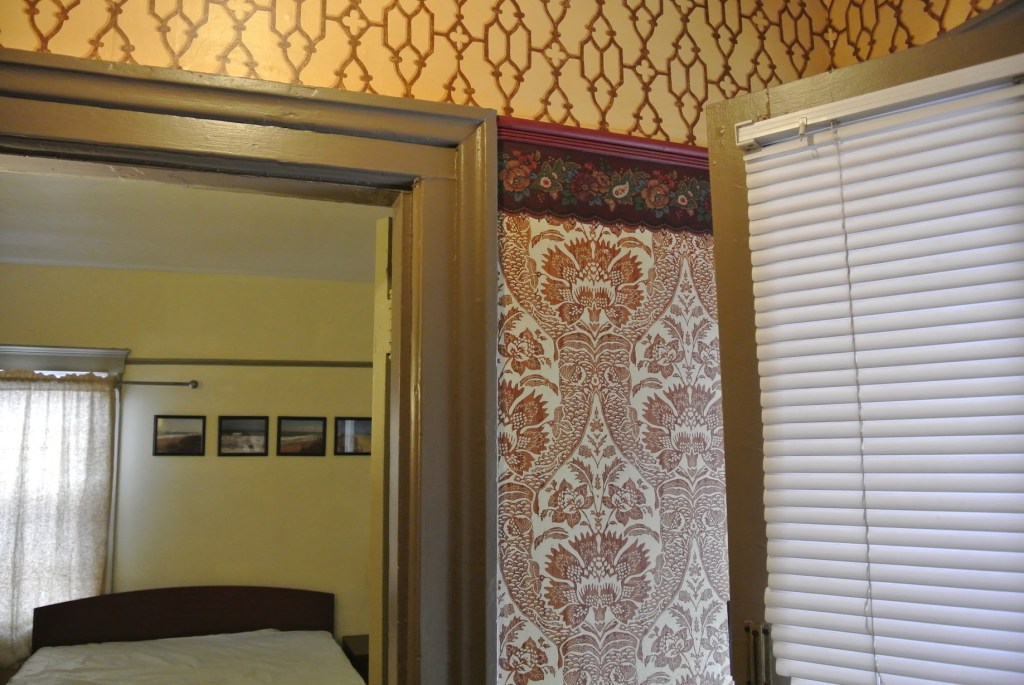
I colorized this photo and enhanced it, but in my memory it should have more gold tones. What a lovely and elegant 60’s style entry way to 2629 Danbury Lane, Ann Arbor, MI The pocket door on the left side was the doorway to the kitchen.
The dining room at 2629 Danbury Lane, Ann Arbor, MI – photo from the mid 1960’s.
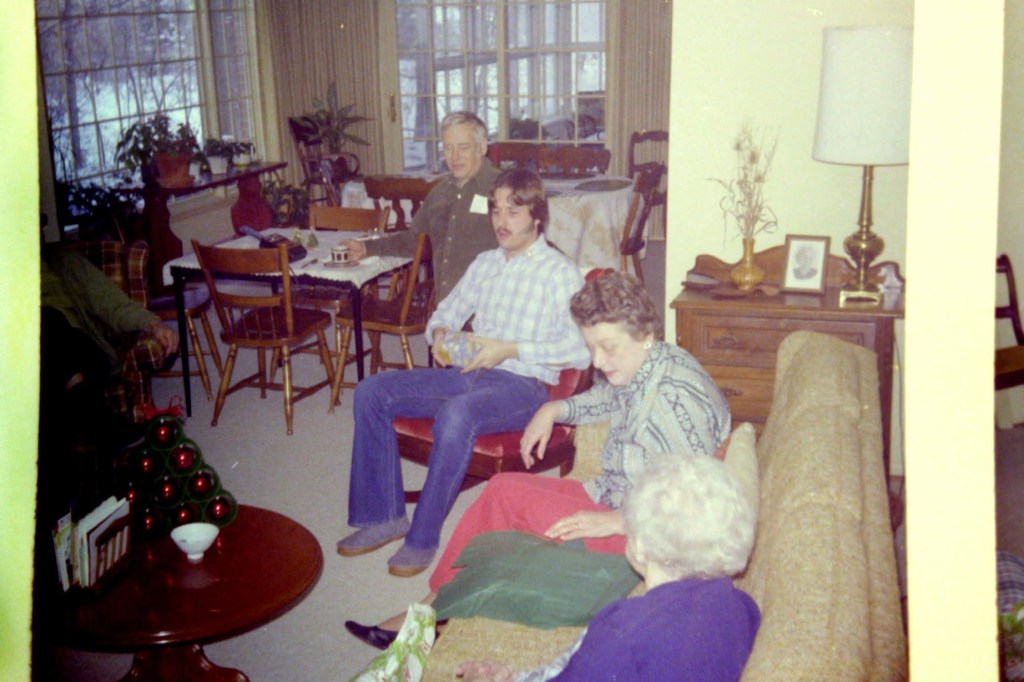
This photo shows the wallpaper in the dining room at 2629 Danbury Lane, Ann Arbor, MI. My Heritage dates this photo with 86% accuracy as 1977. Pictured are: Robert Hess, Tim Whitmer, Madalyn Klotz and ? (this does not look like Aunt Babe to me???)
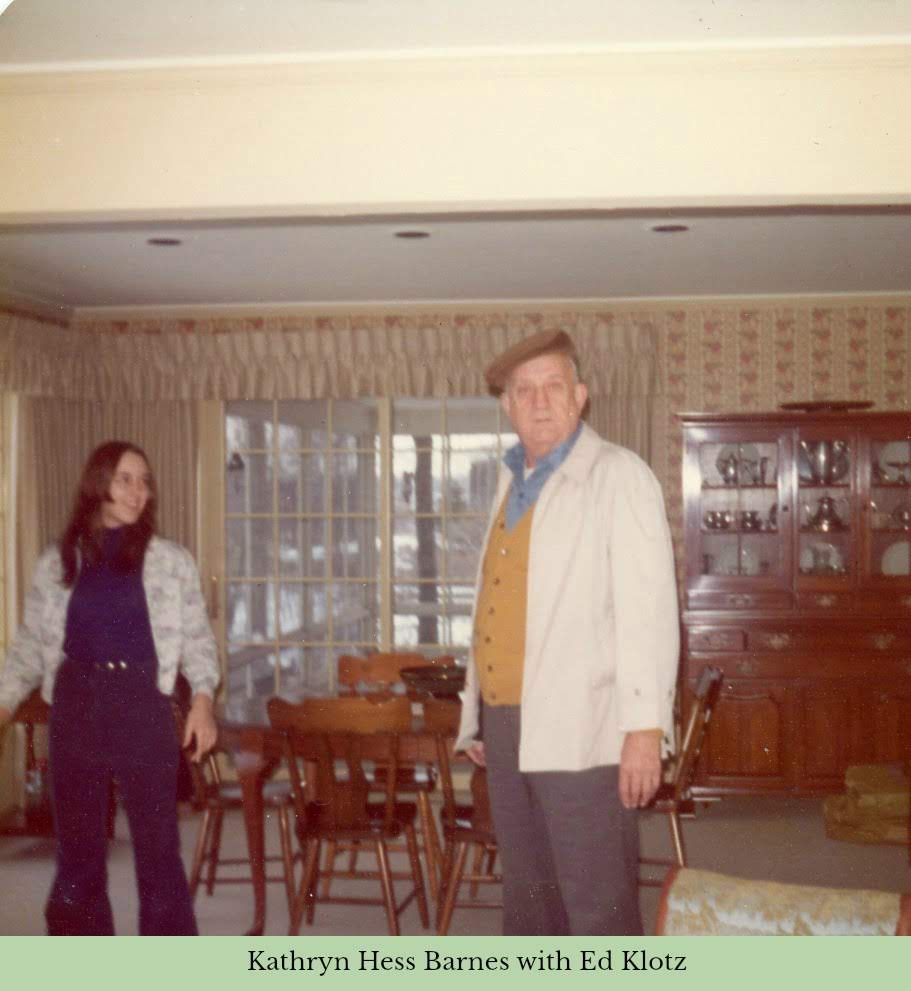
This photo is estimated as 1975. The Dining Room of 2629 Danbury Lane, Ann Arbor. The door wall leads out to the enclosed back porch.
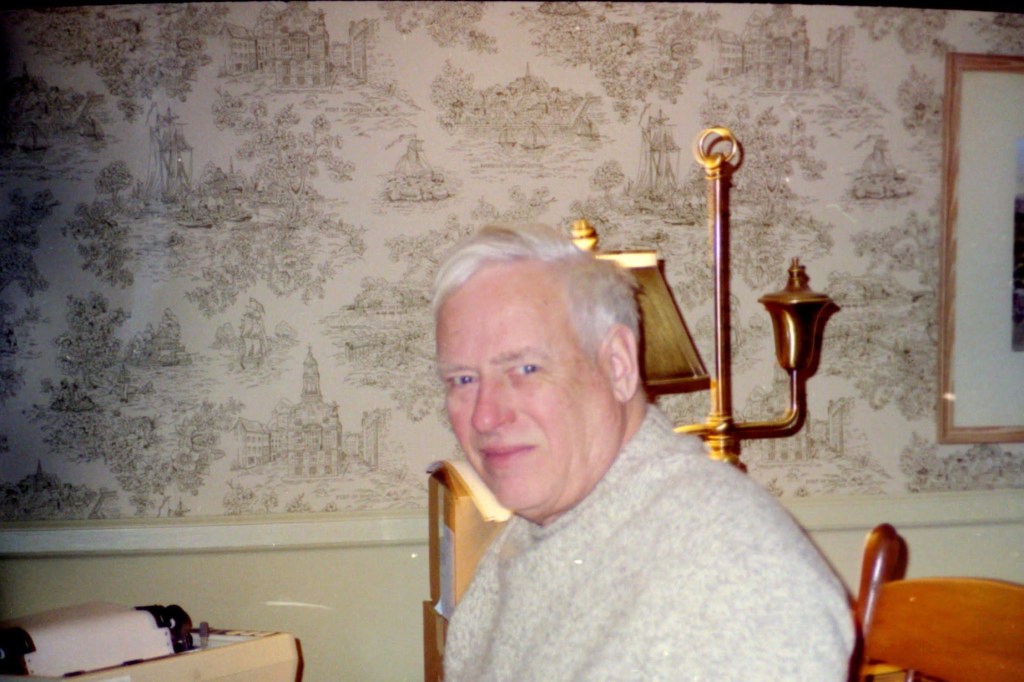
I am dating this wonderful photo of Dad at about 1990. He is seated in his study at 2629 Danbury Lane, Ann Arbor, MI . I adored this wallpaper and the study. This was also the location for our piano.

When Mike was in college at the University of Michigan, he rented an apartment near the Law Quad on Oakland Avenue. Honestly, I don’t think anyone could ever top the creative use of wallpaper in that place. It was boldly expressive and always sparked conversation.

I’m still a little distraught that I can’t find the photo I took of the living room ceiling—it was covered with a huge quilted star that was absolutely unforgettable. The image below is from the entryway of that apartment, but the ceiling is the one I wish I could show you!

The front hall to Mike’s apartment on Oakland Ave., Ann Arbor. This wallpaper design was carried through into the living room and was really quite remarkable.

The wallpaper story that immediately comes to mind for me is Mike and I trying to remove a Winnie-the-Pooh wall border in the house at 2725 Yost Blvd. It must have been super-glued to the wall. We were so determined to get the job finished before our exchange student arrived that we worked ourselves into total exhaustion. Somewhere along the way, fatigue turned into slap-happy delirium, and the whole miserable task became oddly hilarious in retrospect.

Words that hurt – a short story by Linda Claire Groshans

This is a fictional writing exercise.

This is a fictional scenario involving a man named RR, a psychiatrist by profession, who is in the early stages of a new, healthy romantic relationship with a woman named Lydia. Although RR’s professional life centers on mental health, insight, and care, he is not Lydia’s doctor and does not relate to her in a clinical role. Their relationship is grounded instead in mutual affection, respect, and emotional safety.

Lydia carries emotional scars from her past. She has previously been involved in two significant relationships marked by verbal abuse, where her intelligence and worth were repeatedly questioned and diminished. Those experiences left lasting wounds, particularly around how she hears and interprets words spoken about her.

When an ex-partner unexpectedly contacts Lydia again and demeans her intelligence, the old injuries are reopened. The contact is brief, but its impact is sharp and destabilizing—because it echoes a familiar pattern of cruelty she has worked hard to outgrow.

RR responds not as a psychiatrist analyzing a patient, but as a lover who sees, understands, and deeply cares for her. His awareness of psychology informs his empathy, but his words come from intimacy, protectiveness, and love—not diagnosis or authority. He writes to Lydia to steady her, to counter the old narrative with truth, and to remind her that the voice that wounded her does not get to define her.

The email becomes an act of reassurance and re-anchoring: an affirmation that she is intelligent, resilient, and worthy of tenderness—and that she is no longer alone in facing echoes from her past.

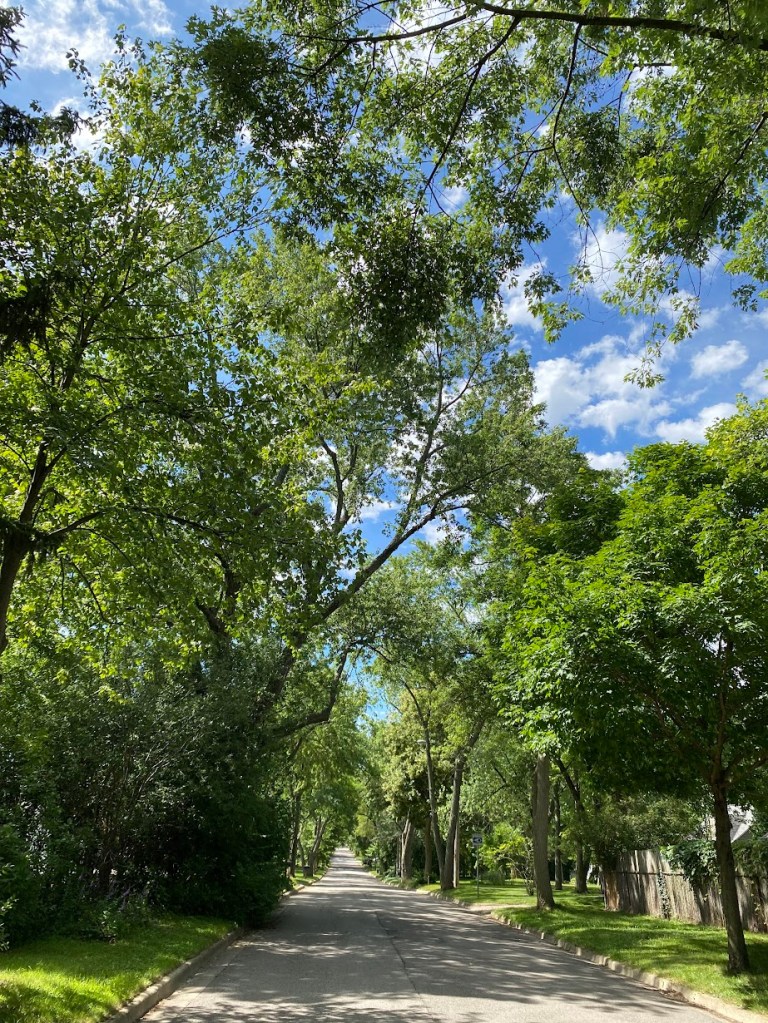
Blue skies ahead

Blue Skies Ahead


My dear Lydia,

I wish with everything in me that you never had to feel this kind of hurt again—because you’ve already carried more than your share. Knowing what you’ve endured before makes me ache all the more when someone reaches back into your life and tries to diminish you, especially by attacking your intelligence. That particular wound cuts deep, and it’s not accidental. It’s a familiar tactic of people who feel threatened by light they cannot control.

Please hear this clearly: nothing that was said to you today is a reflection of who you are. It is only a reflection of the limitations of the person who said it.

You are intelligent in ways that go far beyond cleverness or credentials. You are perceptive, thoughtful, emotionally literate, and deeply curious about the world. Those qualities don’t shout; they endure. And they cannot be taken from you by someone who once needed to belittle you in order to feel tall.

I know words have hurt you before. Repeatedly. When that happens, the nervous system learns to brace itself, as if every sharp sentence confirms an old lie. But I want to offer you a different frame—not as a psychiatrist, not as anyone analyzing you, but as the man who loves you. Words only have the power we grant them, and today’s words do not deserve a permanent place in your heart. They were never truth. They were noise.

There really are blue skies ahead. I believe that—not as a slogan, but as a promise life keeps when we stop mistaking cruelty for insight. You are doing something profoundly brave: choosing health after harm. That takes more intelligence than most people ever muster.

I am so proud of you. I miss you more than I can reasonably explain—like CRAZY, actually. If you want to fly out and meet me, we could make that happen. Truly. The thought of seeing your smile, that sweet dimple that gives you away every time, makes me laugh out loud.

Before you sleep, imagine this: I’m kissing that happy face goodnight and reminding you that you are safe now. I’m here. You don’t need harsh voices in your life anymore—inside or out. What happened today doesn’t undo your growth; it highlights it. You didn’t collapse. You noticed the pain, and you reached for connection instead of silence. That matters.

We can talk about this as much or as little as you need. I know the words wounded you. But if you’re willing, let’s turn them into something else—not armor, but strength that stays soft. That’s your gift, Lydia: you don’t harden; you deepen.

Sleep well, brave heart.
I love you.

RR

My dream – 01/25/2019

Dream:
I had a dream that EKB was standing at my front door. I knew he was supposed to be dead, yet there he was, alive and knocking. The weight of disbelief hit me as I opened the door. I told him how heartbroken I had been, how many hours I spent crying, mourning, and saying my farewells. I admitted that I’d even confided in my lawyer, questioning whether his death had been a lie — or perhaps, orchestrated for reasons I couldn’t understand.

EKB, with a tired and fragile look, explained softly that he “had to do that”—pretend to be dead. The exhaustion was clear on his face as he sank onto a nearby surface, gazing up at me. He spoke in a low voice, revealing that his death had been a ruse, part of a larger, dangerous situation he had no choice but to escape.

I turned to go back into the condo, trying to process the surreal encounter, but when I entered the kitchen, EKB was suddenly there with me. Without warning, he opened a massive barn-sized door—one I had never noticed before, hidden in the back of the kitchen. It led into a cavernous room, one so vast it could have housed four garages. Inside, the room was filled with odds and ends: old furniture, janitor sinks, forgotten relics from neighbors’ condos. And then, I noticed something strange—a square area, completely empty.

I stepped inside, a feeling of awe washing over me as I realized the space was mine. It felt like an undiscovered treasure, a room I had never known existed. As I moved my eyes across the cluttered space, I saw other people, their figures distant and blurry—some were moving things around, others casually strolling with baby carriages. Despite the chaos, I felt a profound sense of joy and amazement. How could I have missed this all this time? It was as if a hidden part of my life had just been revealed.

But EKB, still visibly drained, tried to lay down on a small, uncomfortable piece of furniture. I offered him my bedroom, but he was too weary to stand or even make it up the stairs.

At some point, I glanced out the window. There, in the shared driveway below, a strange scene unfolded. On the opposite side of the drive, children’s riding toys were scattered about, and it looked like a garage sale was set up, a jumble of items waiting to be sold. I told EKB we should go outside. Slowly, he dragged himself up the outside stairs with his hands, each movement a struggle.

When he reached the top, I noticed his legs—swollen, bloated, and painful. His feet looked the same, as though the weight of his suffering had seeped into his very body. I told him, my voice filled with concern, that this wasn’t good. With great effort, I reached out, pulling him upright, my arms straining to lift him. But then, something magical happened.

In an instant, we were dancing, as if the very air had shifted around us. EKB’s strong arms enveloped me, lifting me off the ground, and together we danced among flowers that seemed to bloom from nowhere. The world around us was vibrant with color, flowers cascading in every direction, filling the air with their fragrance. I felt weightless, suspended in his arms, lost in the pure joy of the moment. I pointed out each flower, naming them for him, as if they too were part of this fleeting dream.

There were arbors draped with blossoms, arches overhead that seemed to stretch into infinity. We moved effortlessly, the rhythm of the dance carrying us through a landscape of beauty and peace. In that moment, I was free, surrounded by love and the sheer beauty of the world. But as quickly as it had come, the magic disappeared, and EKB was gone.