Category Archives: Uncategorized

Adeline Wiesner 1912-1978

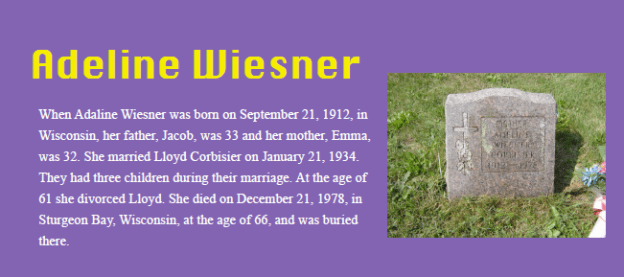
Adeline Wiesner

When Adaline Wiesner was born on September 21, 1912, in Wisconsin, her father, Jacob, was 33 and her mother, Emma, was 32. She married Lloyd Corbisier on January 21, 1934.
They had three children during their marriage. At the age of 61 she divorced Lloyd. She died on December 21, 1978, in Sturgeon Bay, Wisconsin, at the age of 66, and was buried
there.

It was difficult to research the life of Adeline. I found some date details, but was unable to find the “story” of her life. Adeline was an older sister to direct descendant Norbert “Nick” Wiesner. Adeline was 5th in the birth order and descendant Nick was the 7th in birth order and he was also the youngest child.

Adeline was born on September 21, 1912 in Wisconsin. Her mother was Emma Bork born in 1880 and her father was Jacob Wiesner, Jr. born in 1878.

In the 1930 census, Adeline was 18 years old and lived in Nasewaupee, Door, WI. She still lived with her parents but lists her occupation as seamstress in a dress making shop. Her father lists his occupation as farmer on a dairy farm.

On January 21, 1934 she was 21 years old and joined in marriage to Lloyd Corbisier.
A private law (see attached-next page) indicates that Lloyd was occupied for some time by the U.S. postal service in Sturgeon Bay, Wisconsin.

A 1958 city directory from Green Bay, Wisconsin, shows his occupation as construction.
A Wisconsin divorce index shows that at the age of 61, Adeline divorced Lloyd. She died at the age of 66 in Sturgeon Bay, Door, Wisconsin and was buried there.

Burial:
Schumacher Cemetery
Sturgeon Bay
Door County
Wisconsin, USA
Plot: Section 2

Lloyd’s grave marker indicates
that he is a U.S. Navy veteran.
Burial:
Stevenson Cemetery
Door County
Wisconsin, USA

Adeline and Lloyd had 2 or 3 children. I was able to find documentation of their two sons, and only some slight evidence of a daughter.

These children would have been the 1st cousins of Eugene Norbert Wiesner.
Some evidence suggests the daughter’s name was Marlene. No other information available. The eldest of the two boys was James Larry Corbisier 1935-1989.
The youngest son was Robert Roland Corbisier 1937-1989 from Sturgeon Bay, Wisconsin.
see photo of grave marker on next page.

Schmiling Family History and Memories from newspaper and family stories – compiled by Linda Claire Groshans

From Ahnapee Record Thursday, May 25, 1893

Mrs. Chas. Schrailing

“Maria, widow of Chas. Schmiling, died last Thursday, May 18, 1893, at the home of her son, Albert Schmiling, in the town of Ahnapee. Mrs. Schmiling was one of the pioneer settlers of Ahnapee; she was held in high esteem by neighbors and friends. She had been an invalid for a number of years, her disease becoming more complicated this spring and developing into dropsy from which she died.

Mrs. Schmiling’s maiden name was Maria Westphal. She was born in Zarpen, Pomerania, June 4, 1814. In 1835, she was married to Charles Schmiling, who died in Ahnapee town in 1885. Nine children were born to them, four of whom are still living. Henry Schmiling, of this city, Albert Schmiling and Mrs. Chas Damas of Ahnapee town and Mrs. Chas Noll, of Waterford. She came with her husband to America in 1857, and settled in the town of Ahnapee where she had ever since resided.

The funeral took place last Saturday from the Evangelical Lutheran Church in this city. Rev. F. J. Eppling officiating, and was numerously attended. Among those present at the funeral from abroad, was Mrs. Chas Noll, daughter of the deceased, of Waterford, Wis.”

Also, on the same page as the above:

“A band of gypsies have gone into camp near Albert Schmiling farm on the north river road. There are about fifteen people in the band and they are a motley looking set. They have about a dozen horses and mules with them. Fortune telling is an important factor in their business and through it they add many dollars, it is said, to their store of cash. The camp is visited quite extensively, though principally by those only who are curious to see how the wondering homeless people live and work.”

Albert and Johanna

I know nothing of Albert’s early life. I assume he was a typical farm boy of his time with a minimum of education and plenty of chores around the farm. His older brother, Henry, served in the Civil War but Albert would have been too young.

The earliest I can recall anything that was said about Albert was that he fell hook, line and sinker for his cousin Johanna. This according to Minnie. She said she understood Albert had gone out with other girls. Johanna, or Hanna, for short, came over with her parents, Gotlieb and Caroline Grunewald, in 1872, from the Kolberg area of Prussia. (There are also other spellings of Grunewald.) She was eighteen at the time. Johanna’s mother was Albert’s right aunt, or his father’s sister. Hanna was about three years younger than Albert.

I’m almost positive Albert knew of his cousin before he met her. There must have been some letters going to Germany as well as some from there to here.

Albert and Hanna were married June 20, 1874, two years after she came here. They had seven children who lived to adulthood.

*Hanna’s parents settled on a farm near Kolberg, Door County.

Albert must have started dairy farming on a larger scale than his father, Charles.
He had a fairly large dairy barn built. The basement area could hold about a dozen cows
and a pen for young stock. It had a mow overhead. The basement part was about thirty
by thirty plus a 30 f t . mow and thrash floor at ground level about 60 f . i n all by 30
f t . wide. Part of t h i s barn still stood until 1939. The ground level part, or north end, was torn down i n 1917 to make way for the new barn built by Herman. The rest was
torn down to make room for the present machine shed and granary, again by Herman.
Before the Civil War, wheat and peas were major crops in Wisconsin. When the western
lands opened up the land here got to be too expensive for such crops, so dairying was
pushed. At first, cows were only milked during the summer months. The cheese factories
closed down as colder weather came and pasture was gone. Albert held a check too long,
according to Herman, and, the owner of the cheese factory had taken the money out of the checking account. Albert had to see him personally to get his money.
Women used to make butter at home from what ever milk they could get in winter. They
tried to get enough extra to sell in town to help pay for groceries.
According to Herman Welter, who owned the present Elbert Schmiling place, Albert had
a very commanding voice. He could be at the far corner of the farm and still shout instructions to his sons, Carl and Hugo, as they worked near the buildings.
About 1888, Albert built the brick house on the home farm, now owned by Clarence and
Anna Mae Alexander. Herman Schmeling remembers him saying many times about how all the things that could fit into a pocket, like door hinges, locks and nails were the most
expensive items to buy.
Ed Paape’s father was the carpenter who started the house. The Paape’s l i v e d just
north of the Hilton’s, or, present day, Stoller farm. I remember Ed as being somewhat
older than my father, Herman, but I don’t know his father’s name. Paape had much of the framing up when a big wind storm blew the entire thing down. He became disgusted as he looked over the mess and told Albert he was too busy to clean up the wreckage and start over. After some delay, Paape managed to get another carpenter to take over.
During the great fire of 1871, also called Peshtigo Fire, my brother Walter, recalls
hearing that the fire truck in the area during thrashing season, and, the men in the
area, and, I assume, this included Charles and Albert, helped move a thrashing machine to Lake Michigan so it wouldn’t be burned. Thrashing machines were scarce items, and,
thrashing by hand didn’t appeal to the area men. I don’t think any fire struck the home
farm, Walter said the Kolberg area, in Door County, had quite a bit of damage and the
area was just starting to green up the next year when Johanna and her parents arrived.
At the 100th anniversary of St. Paul’s Lutheran Church, in Algoma, the son of a —
former pastor was preaching the sermon. He was recalling some of the things his father
told him about the Algoma area. He mentioned how the fire of 1871 raced toward the church on gale force winds. The men did all they could to beat back the fire in the area of the church but the wind was very strong and at last when it seemed hopeless, the pastor had everyone kneel down to pray and, shortly thereafter, the wind switched. The fire moved in a different direction and the church was spaired. Incidentally, Charles was a charter member of St. Paul’s.
When Albert died in the accident with the train, Hanna had what might be termed a
nervous breakdown. She was unable to function as either a mother, or manager of a farm. Carl and Hugo were already married and on their respective farms. That left Minnie, Martha, Herman, Elsie and Hulda at home. If my figures are right, Hanna was 49, Carl was about 29, Herman 19 and Hulda 9. Charlie Krause was appointed overseer, or guardian, of the ones at home. (Charlie Krause was the father of August and Martin Krause and lived in what I remember as the Martin Krause farm, near present Elbert Schmiling place.) Hanna’s sister-in-law, Ida Meister Grunwald, took Hanna to her farm home i n the Kolberg area. I don’t know how; she accomplished it, but, I understand she worked Hanna from dawn to dusk, never giving her time to think about herself, (source, Bertha Heuer, daughter of Gothilf and Ida). Ida was also a widow at the time. I don’t know anything about Ida, but, I recall Herman saying Hanna had only one brother, Gothilf. He was a hunch back as the result of a bad fall as a baby. He had red hair and a number of his children have red hair.
Charlie Krause used to try and come in on a daily basis to see that things ran
smoothly. I don’t know how long this went on, but it must have been for at least a
year. Hanna did return , but she never recovered completely. She seemed like a
frightened woman, afraid of any change. Herman, and, I guess, the rest of her children,
had a hard job convincing her to s e l l the farm to Herman. I don’t know how the farm
was operated during this time but Hanna must have had a widow’s share of the farm if
she didn’t own it all herself. There were things Herman wanted to do and improvements
he wanted to make. He especially wanted to build a new barn. It took from 1903, when
Albert died, until 1917 before Hanna sold the farm to Herman, with a bond of support.
What I remember mostly about Hanna was that she was an invalid . We had to bring
her to the table i n a wheel chair. She was bedridden f o r the last year of her l i f e.
She died on the Easter weekend of March 27, 1937. She and Albert are buried on the
Evergreen Cemetery, on Hy. 54, west of Algoma.
I remember Bertha Gruendeman, Hanna’s sister , living with us. Bertha was blind,
having had an operation f o r cataracts that wasn’t successful. The two old ladies used
to sit in the front room and talk for hours. They talked about things that happened
yesterday, last year, and, a l l the way back to their girlhood in Prussia. Bertha was
married before she came here and did not come with her parents like Hanna did. I remember her saying the year they got here was a very early spring. It got so warm a
few of the farmers planted grain the last week’ of February. Most farmers wouldn’t take
such a chance. As it turned,out, the early birds got the worm. It turned rather nasty
after that, never too cold, but, with some snow and later rains. Spring planting got to
be late. There was a dry spell and grain didn’t do well. The farmers who planted early
had a good crop.
These are recollections from my brothers, Walter and Reuben, and some from what I
remember. Living with a grandmother in your home brings in quite a number of older
relatives. They are bound to speak of things gone by and little people have big ears,
There may be errors in this history, but, it is the best of my recollections. I welcome
any comments, additions, or recollections from any family member to help make this a more complete history.

Lloyd Schmeling
March 13, 1984
Note: The Carl Schmiling I refer to, as a reference source, should not he confused with
Charles, who sometimes signed his name Carl, especially on the warranty deed conveying the farm, to Albert, Charles, or Chas., also called Carl, was born i n 1811, i n Prussia. The Carl I refer to for reference was my oldest uncle born in 1875, and, the one I went to for information right after my father’s funeral.

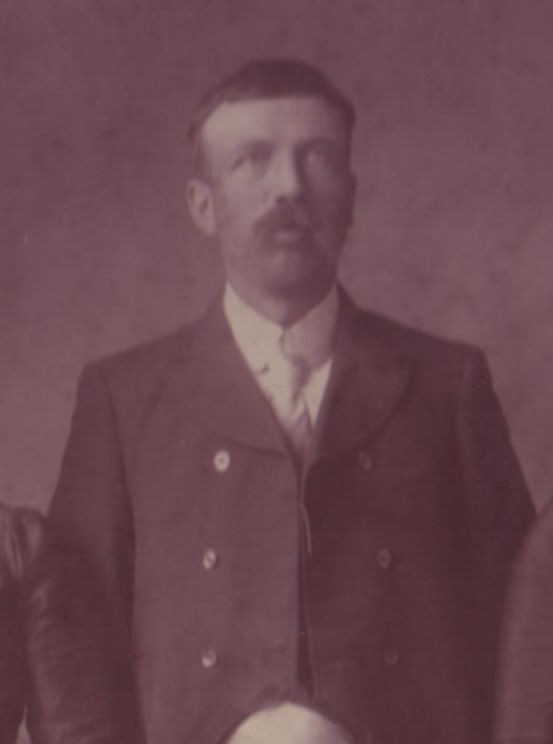
Ole Engebretsen Viste 1869-1936

Ole Viste

Ole Viste

Viste Family about 1921

OLE ENGEBRETSEN VISTE When Ole Engebretsen Viste was born on October 22, 1869, in Viste, Oppland, Norway, his father, Engebret, was 51 and his mother, Ragnhild Knudsdatter Windingstad was 45. He arrived in the United States on June 15, 1882 at the age of 12.

He married Emma Olson on June 6, 1900, in Forestville, Wisconsin.

Marriage of Ole Viste to Emma Olson on 6 June 1900

He became a naturalized citizen of the United States on September 7th, 1910 at the age of 40.

Ole Viste naturalization 7 Sept 1910

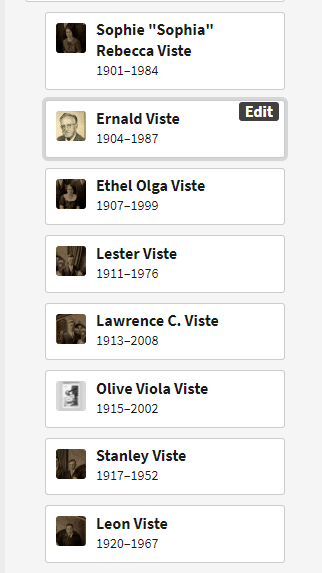
Ole and Emma had 7 children in 19 years. His daughter Olive Viste would become the direct ancestor of our family.

Ole and Emma Viste's children

He died on April 1, 1936, in Forestville, Wisconsin, at the age of 66, and
was buried in Door County, Wisconsin.

http://genealogytrails.com/wis/door/history/history1917_chapter47.htm This link tells about the history of Doorbanks, WI and the Norwegian community early settlers.

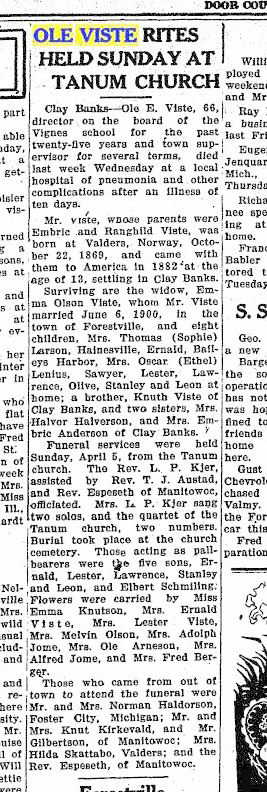
Ole Viste death 4.10.1936 Door Co. Adv.

10 April 1936 The Door County Advocate


Grave marker for Ole Viste

Schmeling Family History compiled by Elbert E. Schmiling

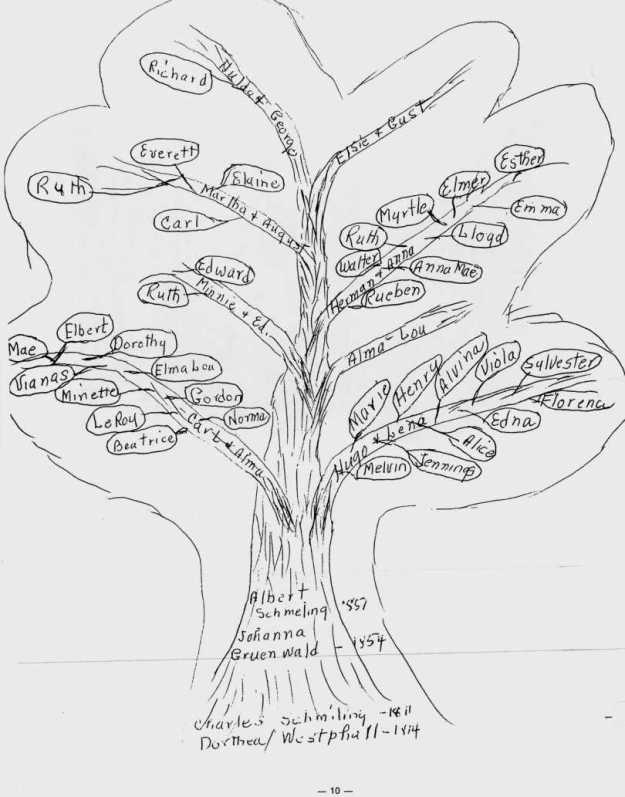
Family tree from records of Elbert Schmiling

From the Family Tree records of Elbert Schmiling

How wonderful that Elbert Schmiling wrote a family history that begins with the story of Charles Karl Schmeling and his wife Dorothea Maria Westphal.

This is a link to Elbert’s narrative account about Charles and Dorothea:

https://drive.google.com/file/d/1x6acY9RDXa_er9aoqSrVTLuxylKBNQwX/view?usp=sharing


Below is a preview of the history written by Elbert Schmiling dated April 1, 1984

We start our family history in the German Country of Prussia. Hinter Pommern, in or near the village of Treptow. What we call Germany did not come into existence until after our Civil War. The Province of Pomerania was divided into three parts: Fore Pommern, Mitte Pommern and Hinter Pommern. Hinter Pommern was closest to the Polish border. (Pomerania is the present spelling.)

Since WWII, all of Pomerania is part of Poland and all German people had to leave this area. They were restricted as to what they could carry out in both money and goods as they left.

Our great grandparents, Charles and Dorthea Schmeling owned a small farm in or near the village of Treptow. Charles was a rather unsettled person. The family had to move on the average of every two years because Charles traded the place for a different one. The last two years in Germany were the worst for the family as they had to move six times. This must have been too much for Dorthea. After the sixth time, she demanded they sell out and go to America. (This according to Carl Schmiling.)

This is not as sudden as it seems, as they had correspondence with relatives and former neighbors who were in America. Two names (given by Minnie Detjen) were Schieser and Buege. There were also companies making a business of getting immigrants to the U.S.

As close as I can tell, Charles and Dorthea came over in 1857, which would make them in their mid-forties. They had five children at the time. Henry, Hanna (perhaps Johanna), Caroline, Alvina, and our grandfather, Albert. Albert was about five or six at the time and the youngest. I believe I have all of them named in order of their ages as Minnie recalls them. (In a note from the Krueger family book, Brown County Library, they stated that the fare across the ocean was about $20.00 per person. Their ancestors came from Niederhagen, Pommern, in Prussia, about the same time.)

The family passed over a great deal of very good farm land on their way from the east coast of America. They did not have the money to buy developed land (according to Carl). Their destination was the village of Ahnapee, as Algoma was then called. Ahnapee is an Indian name and means Wolf River.

…section omitted…

Charles homesickness for the old country would not cease. (This according to Herman Schmeling.) Charles offered his oldest son, Henry, a pair of cooper toed boots if he would go back to Prussia with him. This must have been a tempting offer, as Herman assured me, copper toed boots were the rage of the young men and boys of that day. Despite all this, Charles laid claim to what must have been about 80 acres, 1 mile north of Ahnapee, on the river road.


Jane Ellen Agens 1894-1919

Jane Agens Hess

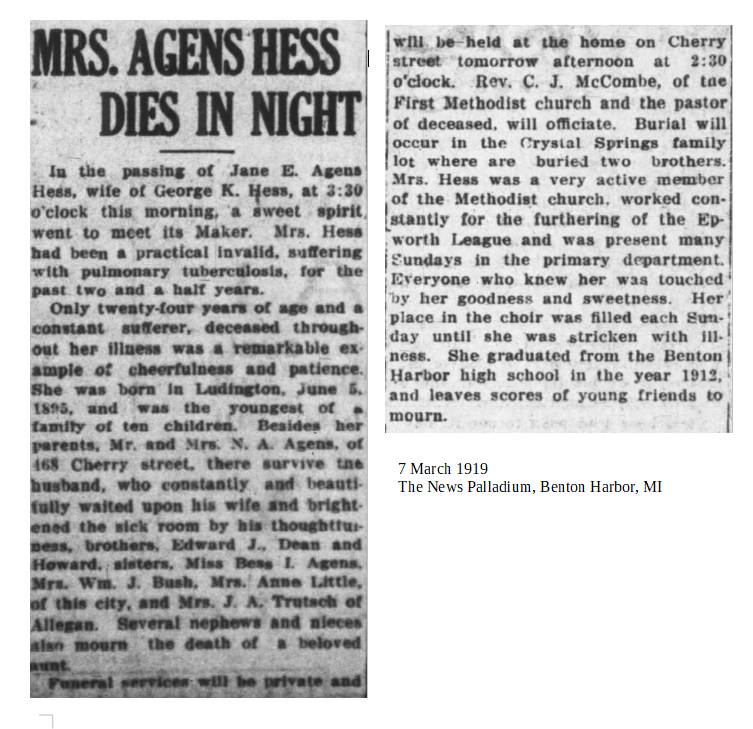
My paternal grandfather,George Kellogg Hess Sr., had a first wife before he married my grandmother. His first wife, Jane Agens, died at a very young age from tuberculosis. George and Jane had no children together.

One day, I had the stark realization that my very presence on this earth was because my grandfather chose to re-marry. I wanted to make sure that my family story included the story of his first wife, and the great love that my grandfather shared with her. In my mind, their story is also a part of my life story! 

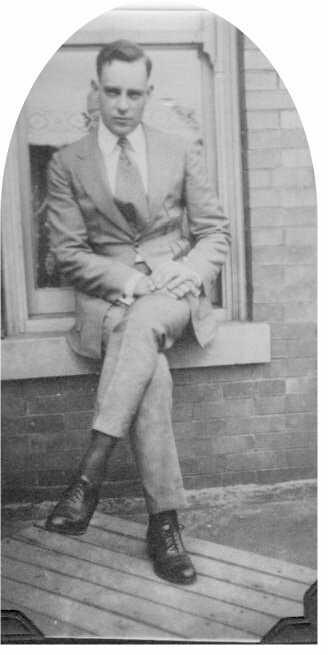
My father told stories about my grandfather’s romance and devotion to his first wife. My father told me that even when his father was not allowed into the sick room, he would sit outside her window and read to her. I pictured that sweet scene many times. I found a photo of my grandfather seated on a window sill. I do not know the date of the photo, but have imagined this could have been him waiting on his wife.

George Kellogg Hess, Sr. on a window sill

George Kellogg Hess, Sr. 1891-1969

Jane Ellen Agens was born on June 5, 1894, in Ludington, Michigan. At the age of 22, she married George Kellogg Hess on April 21, 1917, in Benton Harbor, Michigan. She died on March 7, 1919, at the age of 24, and was buried in Benton Harbor, Michigan.

The ID# for Jane on FamilySearch.org is 9DD5-PN7.  This is a free website.

This is the link for Jane on FindaGrave https://www.findagrave.com/memorial/97244185.

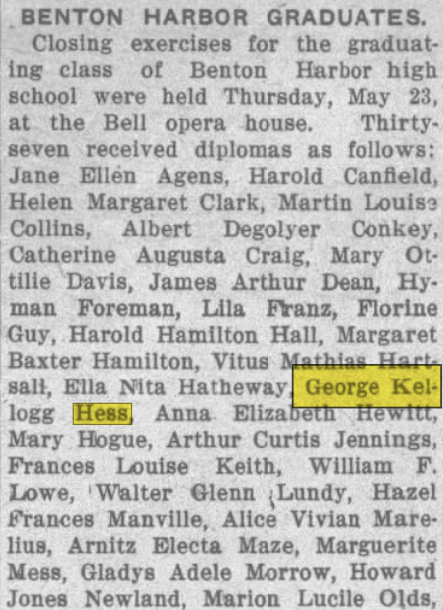
St. Joseph Saturday Herald, 1 June 1912. This article shows that Jane and my Grandfather had attended school together.

The invitation…a short story by Linda Claire Groshans

Linda Claire as story character

“When in doubt…wear red lipstick”

Mary Lou was getting ready to go to the party. The invitation was right there on the vanity counter next to her in the bathroom. As she inspected that invitation for the 100th time, she felt nervous all over again. The extra pounds and years she wore on her body were not helping her self confidence. “Come on,” she said out loud to herself as she started to try to gather some calm.

On her bathroom wall, was a word-art sign that she had purchased years ago. She read it with a half smile, “When in doubt, wear red lipstick.”

“Oh, what the heck!” she thought as she grabbed the tube of red lipstick and applied it to her lips and then inspected herself again in the mirror. It had worked, the red lipstick reminded her that she still had some womanly charms. If fact, she thought, her new pink shimmery blouse was going to be a hit too. But then, inspecting the blouse more closely she noticed that there was a bit of a gap between the buttons at her cleavage. “Drat!” She was nervous again, and then spent the next 10 minutes wondering if she should go. She paced.

Mary Lou calmed herself by running her fingers through her blonde hair and as she did that, she remembered how it felt to have his hands soothing her head.

So long ago. It was all so darn long ago. And yet, there were still so many memories. But, why had she received a formal invitation after all these years of not seeing or being in communication with him. “What are you up to?” she pondered as she returned to viewing herself in the bathroom mirror.

“Oh, you goose,” she said out loud to herself. “Everyone gets older…he probably looks ancient by now.” And then she actually laughed out loud as she tried to picture him as an old man. She imagined his waistline was no prize now either. She added a couple of age spots to his face as her imagination continued to gather the reality of time spent apart. She continued to fantasize about his aged physique because it was an entertaining thought for her and helped her anxiousness.

Mary Lou now performed her signature “ego value thinking” as she tried to reclaim her feeling of being “worth it.”

Well, actually, Mary Lou felt good enough about herself that she started to dismiss her anxiety. “Who cares what that old codger thinks of me!” She thought with some indignation.

“In fact,” Mary Lou thought “The time he spends with me today will probably be the best time he has spent in the last 20 years!” She smiled at herself. And that smile was an absolute. An ABSOLUTE (in all capital letters) , smile of a fully confidant woman. There she was! “Mary Lou you are completely WORTH IT.” she said to herself.

She grabbed the invitation and stuffed it into her party purse. It fit in by the compact mirror, the pink blush, the tube of red lipstick and a little comb.

The roads are quiet. She arrived at his home at the exact time she had planned. The home looked stately, almost Romanesque. A powerful house for a powerful man. “A powerful OLD man,” Mary Lou corrected her thoughts.

Mary Lou looked in her rear view mirror before she opened the car door. The lipstick was still good. She looked down at her chest to make sure the blouse button had not popped open. Then, she threw open the car door and made her way to the door. And as she walked, she gathered her self esteem and thought to herself that she would probably actually hypnotize him with her charm.

But, what greeted her when the door opened was a surprise she never could have imagined.

Part 2:

There he was standing in the entryway to greet her. His outfit and appearance were impeccable, but he had clearly aged.  In his hands, he held a large poster board sign with words handwritten in black marker, it said, “I can explain.” His face and body suggested a nervous pose as he studied her for a reaction. Then, he tried to reach out to her with his open arms for a hug, but his attention was not returned. Mary Lou was looking past him into the hallway.

The hallway had 7 original, large, and distinctive framed artwork pieces. And the artist for each of those pieces had been Mary Lou. It appeared that these pieces of artwork which Mary Lou had sold over these last 20 years since she had left him through the local art gallery, were now in the possession of her old love interest, Roger. She was too stunned to have an immediate reaction, but she could hear her own small voice saying simply, “What have you done? Why? What have you done?”

Then,Mary Lou looked at him with disgust.

“Mary Lou, it isn’t what you think.”, his reply was hideously lame. “Please, let me explain.” he continued.

While she walked the hallway with growing agitation, she examined her own work.

He quietly said, “Please, I beg you, let me explain.Will you believe me when I tell you that I did this all as your truest friend?”

“No.” she glared at him. “This is unforgivable.”

“Please listen.” Roger implored her while he was wringing his hands and looking at her with fear and trepidation in his face.

They were both silent for a long time before she said, “You know what Roger, you do owe me an explanation. In fact, I can’t wait to see how you are going to rationalize this theft of my very creative nature.I want you to try to muddle your way through this story. And, after I listen to your lame apology, I want you to package each of the paintings and have them delivered to my house.”

Mary Lou took careful pleasure in walking with her head held high to the easy chairs in the lounge. Roger sat facing her in an arm chair. Mary Lou looked at him with loathing. Roger stared back in a fearful gaze. He started his explanation:

“It started out in innocence,” he began.

Mary Lou scoffed, but Roger continued…”I found one of your paintings at the gallery and I realized right away  that the subject matter had a deeper meaning. I could see that you had not randomly selected  just any good painting subject.”  Roger leaned forward with a hopeful look on his face. “I could tell you were recording history in a very novel way. I could see what you were trying to communicate.”

“What a line,” Mary Lou spat out, but she was also now the one to be a bit nervous. Had Roger really figured out her motives?  “Well, please continue your pathetic nonsense,” she said in an effort to cover her own growing suspicions.

“He knew? He had figured it out? The secret of the paintings was now no secret at all?” Mary Lou thought to herself. She was becoming uneasy and shifted in her chair trying to hide her growing anxiety.  His knowing changed everything.

As Roger stared at her, Mary Lou looked down at her blouse to make sure that the wide gap between the top buttons was not the object of his stare. She also wanted to check her lipstick again but only because she wanted to feel in control again…but it was all slipping away. Roger knew that the paintings were a code.

“My God,” Mary Lou shrieked inside her own mind. “He knows, so now what?”

Claire’s response – a short story by Linda Claire Groshans

Claire’s son had been involved through out his middle school years in the boy scouts. His troop was known for many fine things including their great overnight trips and adventures. The troop was also known for their amazing annual Christmas party which was hosted by a married couple who were also troop adult volunteers. Every December, this husband and wife offered an extravagant party complete with soda fountains, ice-cream cones, and jukebox games and this was all done as their generous way to support the troop. Claire would have recognized those leaders had she bumped into them somewhere. After all, she had dropped her son off at the weekly meetings many times, but she had not stayed to attend those meetings and didn’t really know this couple or the other scout parents. This was because Claire had been happy when her ex-husband agreed to take the lead on being with their son at the boy scout meetings and overnights. It gave Claire a moment of time every week to re-gather from her busy single working mom life. Actually, she usually spent the time on those Tuesday evenings doing grocery shopping. This was also a special time for her son to share with his father.

Well, it was December 2003, and the annual Christmas party was almost here and it was the big buzz in the boy scout troop. Claire’s ex-husband called to say that he had a conflict the evening of the party. He could drop their son off at the party house, but could not stay. No problem, in fact, Claire was really quite curious about seeing this party for herself. She was always socially at ease and wanted to put names to some of the faces she had heard about during the year. This would be fun.

Claire put on a rather nice outfit and checked her clock for the time and then she checked the address as she prepared to leave from her home. Her plan was to find the home and then rendezvous inside with her son at the party. Her ex had already explained that he would just be dropping their son off at the party home.  Claire did not want to be late, but she also did not want to be one of the first guests to arrive. She purposely left about 15 minutes past the time she normally would have allowed. She drove to the correct neighborhood and instantly spotted a house surrounded by many cars with all the Christmas lights beaming from the yard and the inside the home illuminated through every window.

Claire walked up the sidewalk to the entry and found the door open. She entered. “What the heck?” Claire said to herself when she entered the home. “Ding-dong. This place is over-the-top,” she continued talking silently to herself. “Oh man, this is amazing.” The furniture and artwork were almost jaw dropping.

Almost immediately, she was welcomed by a uniformed waiter providing formal butler style tray service with a full variety of canapes. But, it seemed that there were no children at the party. “Now, that’s a bit odd,” she thought. She asked one of the couples sitting there where the children all were. “Oh, on the lower level with planned supervision provided” they informed her. “They have their own special foods downstairs too.”

“WHAT?” the next thing Claire noticed was a full open bar with an obviously experienced and uniformed bartender. No wonder everyone had exclaimed about this annual event. When she approached the bar, she noticed that the liquor choices were all top shelf. She ordered a Manhattan with extra cherries. What a treat!

Claire made her way over to a sofa where some other folks were laughing and enjoying the evening. A grand piano was in the room and soon, an accomplished pianist arrived to play Christmas carols softly in the background.

Claire was determined to give the boy scout meetings more attention in her future! No wonder her ex was always so willing to be a part of this organization.

Eventually, Claire wanted to check on her son. She made her way to the lower level of the home. The basement, like the rest of the house was all decked out and even had a full movie theater set-up. But, the children were not the right age. They were much younger.

“Something is not right,” she thought. Claire went back upstairs. She made her way over to a friendly looking woman and asked, “Where are the boy scouts? I went down stairs, but I could not find them.” The woman looked at her as if she had said something ridiculously funny. “The what?” the woman finally replied. Claire raised her voice over the din of the many on-going conversations. “I’m looking for my son, he is in the troop.”

“I’m sorry,” the lady started out saying “I don’t really know what you are saying, what troop?”

“The boy scout troop, of course.” Claire now looked at the woman as if she was ridiculous. “After all, this is the boy scout holiday party!” Claire said.

The woman now seemed nervous, “This is the party for all those who donated to the local art center.”

Claire’s response…What was Claire’s response. The room was tilting. What was her response…Fear? Embarrassment? Self-recrimination? No time to think about anything. Claire’s response would be the simple flight mechanism.

She ran out of there and fast!

A complete fear that she had made some horrible wrong problem with the address entered her mind. Her hands were shaking as she opened her purse and pulled out her hand-written note with the address printed on it. The street name was correct. “Oh NO…the house numbers were different.” “Is that why there were so many cars on the street?”

With total stealth like moves Claire walked across the street and opened the door to the correct house.

“Your son was starting to get worried about you,” a kind woman said upon seeing Claire. “I hope everything is OK?” the woman continued.

Claire looked around the house. It was nice too. There were several open pizza boxes on the counter along with a selection of bottled waters and soda pops. No canapes. No open bar, just the happy noises of middle school boys coming up from the lower level.

Claire’s response? “Well, it will be my little secret” she told herself. Never will this be spoken of, she thought.

Claire then sat down at the Boy Scout party holding her water bottle and chatted with the other parents. It was perfect. Her son came through the room and gave her a high five before running off to be with his friends again. The evening was saved.

P.S. Claire spent some time in January deciding if she could be a donor to the local art center…after all, she didn’t want to miss that event in her future!

Biography of Dr. Robert Lawrence Hess 1924-2017

Dr. Robert Lawrence Hess

Dr. Hess was born i n New Jersey in 1924 and moved with his father, mother and brother to the family homestead in Berrien County, Michigan in 1930. The homestead was purchased from the local Indian tribes in the early 1800’s and then registered with the Michigan Territorial Government. He attended a rural , 2-room school for his first 8 grades and graduated from Benton Harbor High School i n 1942.

While in High School, Dr. Hess enlisted  in the U. S. Navy’s officer training program, V-12. Assigned to the University of Michigan, he received two B.S.E. degrees from the Engineering College in 1945 and was assigned to the Midshipman program at Columbia
University. He was commissioned as Ensign in October 1945 and married his fiance, Gretchen Lois Ream, in Bethlehem Church, Ann Arbor in December 1945. He served as junior division officer, main engines division , on a heavy cruiser at sea and later as division officer on a pair of light escort carriers. Upon release from active World War II  service he returned to Ann Arbor, the home of his wife.

Subsequently he was hired by the Dean of the Engineering College at Michigan as a full time Instructor  and asked to undertake a research project which became the basis of his Doctoral Thesis. “The Dynamics o f Ship’s Structures, including Shear Deformations”.
This work became the first major engineering work to be programmed for the ENIAC,  (Electronic Numerical Integrator And Computer was the world’s first general-purpose computer. ENIAC was designed and built for the United States Army to calculate artillery firing tables.) that being done by the David Taylor Model Basin, Dept. of the Navy, Washington D.C. During the three years of full time teaching as an Instructor , he served in the U.S. Naval Ready Reserve and spent his training periods at the Model Basin. He was honored by being requested to provide 40 hours of lectures at the Model Basin on advanced mathematics and dynamics for the scientific staff of the U.S. Navy when he was 24 years old.

Hess was recruited by the Bell Telephone Laboratories (BTL) and joined BTL, upon completion of  his doctorate, as a Member of the Technical Staff  in the fall of 1949, being assigned to a ‘heavy-tube’ Development Group. The many research projects he led there included the development o f the pilot line for the production of both the material for and the devices known as ‘point-contact’ , type A transistors. This was before the courts ordered BTL to place the technology on the market and was thus a unique endeavor for Dr. Hess upon which several of the newly licensed companies partly based their developments. It was typical of him to have the breadth of both interest and scientific knowledge that brought him such a coveted assignment and also success in it. He developed new techniques of crystal growing and zone-purifying as well as a novel method of doping the contact area using microwave techniques to create photo – sensitive transistors.

In his third year at BTL, the Dean of Engineering at Michigan called him with an unsolicited invitation to return to the U. of M. as an Assistant Professor, of Chemical and Metallurgical Engineering and Engineering Mechanics and to also take on a Phoenix Project dealing with the atomic structure of glass and ceramics. In 1955 he was
promoted to Associate Professor of Engineering Mechanics. He undertook the reactivation of the Engineering Mechanics Department’s Photo-Elasticity Lab. and generated a course for it as well as teaching in the areas of elasticity and dynamics.

In 1957, the University’s Vice President and Dean of Faculties asked Prof. Hess to join an elite committee of engineers and scientists to oversee the work of the Willow Run  Laboratories f o r the Department of the Army. In 1958 Hess was requested to take leave of his teaching and consulting practice and join a management team to direct the Willow Run Laboratories . Hess was given the assignment of Technical  Director o f  Project Michigan, a multi-million dollar a year program , as well as Assistant Directorship of Willow Run Laboratories. He also became the Head of the Applied Research Group of the Labs, which at that time had just demonstrated the MASER and a year later the demonstration of the Ruby LASER. Hess was instrumental in extending optical data processing to the field of automatic photo interpretation. This was of special importance since the surveillance devices developed by Project Michigan were then beginning to assume the prime role of  the national satellite surveillance system. In 1958, he was promoted to a full professorship, a promotion which was said to make Hess the youngest full professor in the college’s history at that time.

Prof. Hess had a keen ability to manage multiple teams of researchers on topics varying from information processing, semiconductor development, infrared scanning and synthetic antenna radar. He was able to apply his knowledge of  basic physics and
mathematics to these subjects both as a member of the research teams and also represented them to general officers representing the U. S. Army, and, upon the creation of a Department of Defense to the scientific part of that community. In his unique fashion and with unusual modesty, his term of management, which after three years included the project directorship as well as its technical direction, Hess always put his staff in the foreground and sacrificed personal fame in the process. Upon his decision to return to teaching, the Department of the Army awarded Prof. Hess with THE OUTSTANDING
CIVILIAN SERVICE AWARD and MEDAL the inscription of which read in part ‘”Hess succeeded  in establishing and maintaining the University of Michigan as the leading free world authority in surveillance technology. His own proven scientific talent and professional imagination contributed additionally to the accomplishments of a
broad team of scientists and technicians. The rare combination of skill , foresight and devotion to country…”

During 1964 and 1965, Hess also served as the personal representative of the U.S. Army’s Assist. Chief of Staff for Intelligence and led teams of scientists through a comprehensive field review of the Army’s Combat Surveillance  capabilities both in Europe and in Korea.

In  1965 Hess left the Project Michigan assignment and returned to full-time teaching.
President Hatcher offered Hess the challenge of using a $10 million gift from the automobile industry to create the Highway Safety Research Institute. This was a special honor as that gift was reported to have been the largest gift in the University’s history at that time. Hess was able to devote his attention to building the staff and its research programs and also to continue teaching which was his first love. With the cooperation of dozens of the University’s top faculty, Hess was able in a few years to build a facility, hire internationally known figures and to create a program of research spanning fields from Law to Medicine and from Engineering to Psychology. His untiring drive established the Institute as the world premiere institution of its kind and brought not only many millions of research dollars for the support of researchers, faculty, and graduate students but also enhanced the reputation of the University of Michigan. During his tenure at
H.S.R.I., Hess served as a consultant to the Army’ Science Board where he both chaired and participated in the study of many of the nation’s outstanding technical problems and challenges.

Professor Hess personally undertook major research studies while teaching a nearly full load and directing the H.S.R.I. These included a complete review of the research in the scientific, engineering and medical communities of the experimentation protocols in the
area of blunt trauma to the human head and blunt trauma to the thorax. In each case an annotated history of the development and use of the knowledge in research and regulation was made as well as recommendations for future research in the fields. The second area of these studies was selected for publication in the S.A.E. transactions.

Hess also served his university by membership on President Nixon’s Highway Safety Advisory Committee and through several overseas assignments as a Consultant to the World Health Organization. He served his church, Bethlehem United Church of Christ in several capacities including two terms as President. He also was Chairman of the Building Committee which brought about a remodeling of the sanctuary and the addition of a major office / educational wing in 1966.

Prof. Hess resigned his position as Director of U.M.T.R.I., (the successor to H.S.R.I.) and returned to a full time faculty teaching role i n 1984. He founded a computer software company, HCCI, which dealt in the forensic engineering specialty software for an international audience in the forensic engineering area. He undertook the teaching of the senior level Control Systems course with vigor and provided new leadership in its laboratory and course work with several software packages that he wrote to enhance the depth and breath of the educational  experience of the students. These include programs dealing with Fourier techniques, general integration methods, data plotting, frequency analysis, root locus, Nyquist techniques, Myklestad and Holzer techniques, matrix interaction techniques, eigenvalue/eigenvector techniques and many others. He also served as the Mechanical Engineering Program Advisor for over 600 students and wrote degree-audit software packages used by the Mechanical Engineering and Applied Mechanics department. The implementation of modern techniques allowed Professor Hess, as the Advisor, to take a proactive rather than a reactive role in counseling.

Professor Hess’s academic and s service accomplishments were outstanding. The respect that he gained from his peers is only reflective of the credit he had given to them over a total of 37 years of devoted service to the University.  In the Pentagon, corporate offices, the classroom and laboratory he represented the best the University of Michigan could offer its students and country.

In addition to many academic and service honors Dr. Hess i s also recognized by a bronze bust in the lobby of the Institute he founded. He retired from the University in 1991.

Robert Hess – obituary May 2017

OBITUARY

Professor Emeritus, Robert L. Hess, PhD of Ann Arbor died peacefully on May 19, 2017. His wife, Gretchen Ream Hess, proceeded him in death on November 1, 2006. Dr. Hess is survived by his three daughters, Mary Ann (Tim) Whitmer, Linda Claire Groshans and Kathryn Sue (Chris) Barnes. His six grandchildren are Amy (Drew) Wiesner, Michael Groshans, Kristina and Charles Whitmer, Blake and Kevin Barnes, as well as his great grandson, EJ Wiesner.

Dr. Hess was born in New Jersey on September 29,1924 and moved to the family homestead in Berrien County Michigan in 1930. There he attended a rural, 2 room school for his first 8 grades and graduated from Benton Harbor High School in 1942.

Dr. Hess enlisted in the U.S. Navy’s V-12 officer training program. Assigned to the University of Michigan, he received two B.S.E. degrees in 1945 and was assigned to the Midshipman program at Columbia University. He was commissioned as Ensign in October 1945 and married his fiance, Gretchen Ream, in Bethlehem Church, Ann Arbor in December 1945. He served on a heavy cruiser at sea and later as division officer on a pair of light escort carriers. Upon release from active World War II service he returned to Ann Arbor, the home of his wife where, in 1958 he was appointed to a full professorship.

Dr. Hess’ academic and service accomplishments were outstanding. The respect that he gained from his peers is only reflective of the credit he had given to them during his devoted service. He held many academic honors and served the nation as a consultant to the World Health Organization, to the Army Science Board and served as the personal representative to the Chief of U.S. Army Intelligence where he led teams of scientists though field reviews of Army’s Combat Surveillance capabilities both in Europe and in Korea. In addition he was selected to be a member of President Nixon’s first National Highway Safety Advisory Committee. He served with distinction at the University of Michigan where he is honored by a bronze bust in the lobby of the University of Michigan’s Transportation Institute, of which he was the founding director in 1965. In the Pentagon, corporate offices, the classrooms and laboratory he represented the best to his students, peers, academic associates and to his country. The Department of the Army awarded him the Outstanding Civilian Service award and medal.

A memorial service to celebrate his life will be held at First Presbyterian Church of Saline on July 22, 2017 at 10:30 AM.